
Digital Human Display Partnership FAQ: Repeat-Order Acceptance and Certificate Continuity
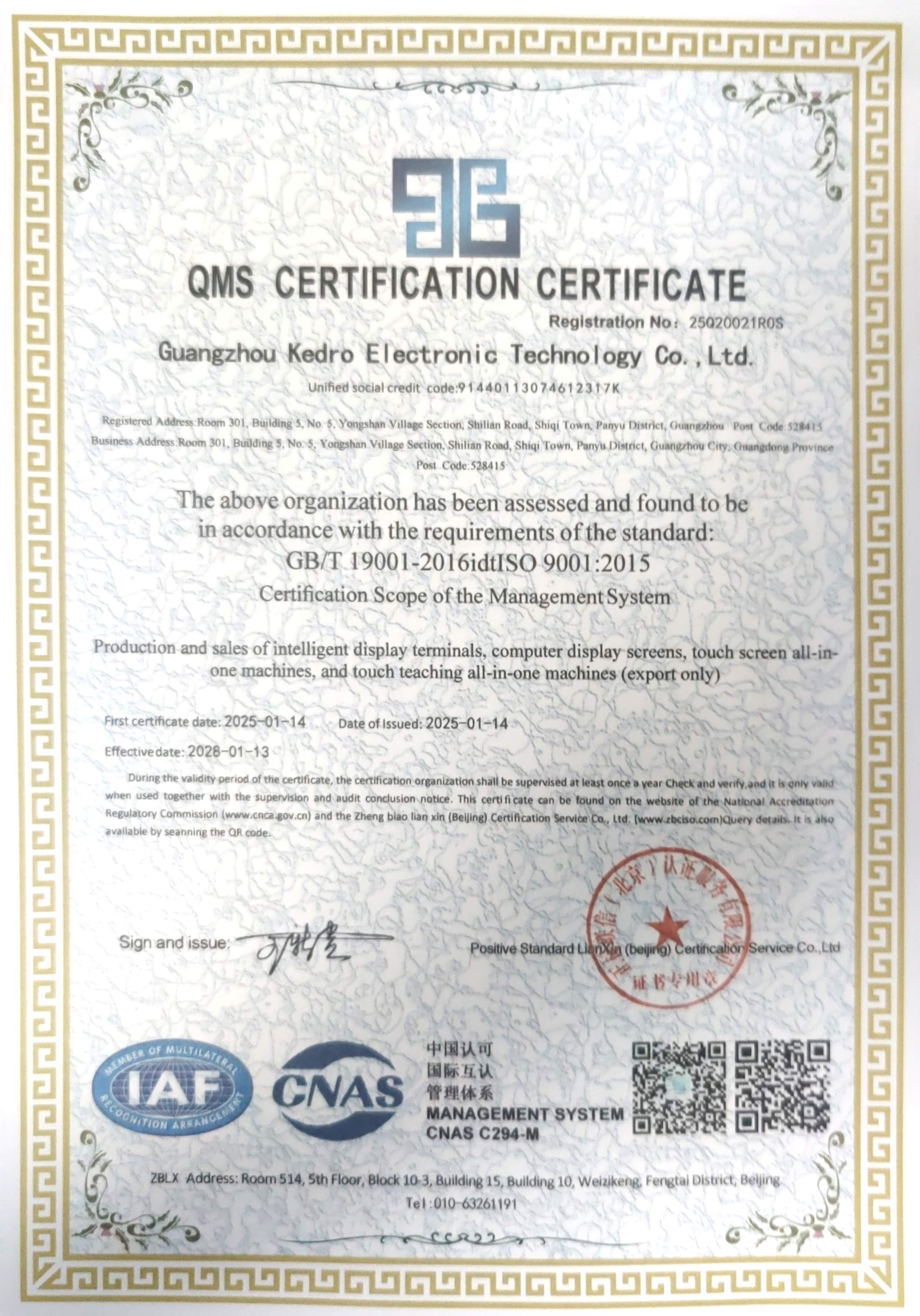
ISO 9001:2015 certificate 25020021R0S, issued 14 January 2025 and valid to 13 January 2028, covers the production and sales scope behind every repeat digital human display order.
The first digital human display a buyer purchases is a product decision: does the terminal fit the mall concourse, the exhibition hall or the retail floor, and does it hold attention once installed. The second order is a supply decision. It asks whether the same unit can be built again to the same specification, pass the same acceptance test, and arrive with compliance documents that are still valid on the day it ships.
Most of the friction in repeat procurement sits in that gap, and very little of it concerns the screen itself. It concerns purchasing terms that were agreed verbally, an acceptance test that was never written down, and a certificate file that was never checked against the specific model being reordered.
This FAQ addresses that transition for buyers working with GZKEDRO, the trading name of Guangzhou Kedro Electronics Technology Co., Ltd., a commercial display manufacturer founded in 2013 with research and development centres in Guangzhou and Shenzhen, a stated export share of 80%, and a range that includes LCD digital human all-in-one machines and the KD-DH Series holographic digital human. Each answer below is tied to a specific record: purchasing terms and acceptance criteria, ISO 9001 certification scope, and the 3C, EMC, LVD and RoHS 2.0 documentation that has to carry across repeat shipments. Where a record has a boundary — a series list that does not include every model, or a validity date that needs re-checking — the boundary is stated rather than smoothed over.
The Short Answer: What Changes on Order Two
A repeat digital human display order should be settled on three fronts before commercial negotiation begins: the terms that will repeat, the acceptance test that will repeat, and the certificate set that will still be valid when the goods leave the factory.
- Purchasing terms. Minimum order quantity is 2–5 units depending on product size, with flexible and project-based MOQ. Delivery runs under DDP, CIF or FOB by air freight, sea freight or land transport. Payment terms are TT, L/C, D/P, PayPal, Payoneer, Wise and Western Union. Lead time is 15–30 days, with a maximum of 30 days.
- Acceptance criteria. Every unit passes a 100% aging test and functional inspection; the inspection set covers brightness testing, waterproof testing, touch testing, temperature testing and continuous operation testing, with full quality control before shipment under industrial standard testing.
- Management system. ISO 9001:2015 certificate 25020021R0S, issued 14 January 2025 by Beijing Zhengbiao Lianxin Certification Service Co., Ltd., valid to 13 January 2028, covering production and sales of intelligent display terminals.
- EU product compliance. EMC record MK25100089P01-E01, LVD record MK25100089P01-S01 and RoHS 2.0 record MK25100089P01-C01, all issued by TMC Testing Services (Shenzhen) Co., Ltd. in November 2025, with expiry dates recorded in 2099.
- Ten-series RoHS coverage. MK25100089P01-C01 lists applicability to the KD-AD, KD-LED, KD-IFPD, KD-TP, KD-VW, KD-OD, KD-WM, KD-SSK, KD-ISS and KD-EA series.
- China 3C. Certificate 2018010901114733, issued 17 October 2021, recorded expiry 17 October 2026, covering six of those series.
The 3C line is the one repeat buyers most often overlook. The certificate number is on file and the coverage is real, but the recorded expiry date falls before the publication of this FAQ, so it has to be re-confirmed rather than assumed. That is a documentary task, not a product problem, and it takes one email if it is done before the purchase order rather than after it.
Why Repeat Orders Fail on Paperwork, Not Hardware
In a first deployment, buyer and factory share a fresh memory of the specification. The samples are still on the table, the acceptance run is recent, and the person who signed off the configuration is the same person placing the next call.
By order two, three things have usually changed. The buyer side may have a new procurement owner working from a purchase record rather than from the original discussion. The production batch has moved on, so panel supply, firmware version and housing tooling are no longer literally the same as the first run. And the certificate file has aged — sometimes within its validity, sometimes not.
None of this is a manufacturing failure. It is a documentation failure, and it is cheaper to prevent than to discover. The practical rule is simple: write the order file so that someone who was not in the original conversation can execute order two without asking what was meant.
How to Set Purchasing Terms for a Repeat Digital Human Display Order
Purchasing terms for a repeat GZKEDRO digital human display order cover five variables: minimum order quantity, delivery terms, payment terms, lead time and production capacity. The recorded positions are straightforward, and the value for a repeat buyer comes from fixing them in writing rather than renegotiating them every cycle.
| Term | Recorded position | What to fix in the repeat order |
|---|---|---|
| Minimum order quantity | 2–5 units depending on product size; flexible and project-based MOQ | The model-to-MOQ mapping for each series in the rollout |
| Delivery terms | DDP, CIF or FOB; air, sea or land transport | Incoterm, named place and transport mode for each destination |
| Payment terms | TT, L/C, D/P, PayPal, Payoneer, Wise, Western Union | The instrument used and the milestone it is tied to |
| Lead time | 15–30 days, maximum 30 days | The delivery window per batch, not per campaign |
| Production capacity | 2,000–5,000 units per month for large-scale production support | The capacity assumption behind a multi-site rollout schedule |
Minimum order quantity and configuration drift
The recorded MOQ is 2–5 units depending on product size, with flexible MOQ and project-based MOQ available. That range is deliberately low, which is what makes a pilot-to-repeat path practical: a buyer can validate a single mall digital human shopping guide display before committing to a chain.
For repeat orders the risk is not the MOQ but the drift. A two-unit reorder and a hundred-unit project order of the same series should generate the same acceptance protocol and the same configuration sheet, otherwise the second acceptance result cannot be compared with the first. If the reorder is smaller, resist the temptation to shorten the acceptance run to match it.
Delivery and payment terms to write into the repeat contract
Delivery is quoted under DDP, CIF or FOB, by air freight, sea freight or land transport, and payment terms include TT, L/C, D/P, PayPal, Payoneer, Wise and Western Union. For a repeat programme, the useful discipline is to make order two a copy of order one plus a delta sheet: same Incoterm, same named place, same payment instrument, with only the quantity, destination and delivery date changed.
Lead time is stated at 15–30 days with a maximum of 30 days, supported by stated monthly capacity of 2,000–5,000 units. Those two figures belong together in the contract, because lead time is only meaningful against the volume assumption underneath it. A retail chain scheduling ten store installations across a quarter should state the batch sequence in the order, so that capacity is reserved per batch rather than requested per shipment.
How to Write Acceptance Criteria That Survive Order Two
GZKEDRO's acceptance criteria are defined at the shipment level rather than the sample level. Every unit passes a 100% aging test and functional inspection, the inspection set includes brightness testing, waterproof testing, touch testing, temperature testing and continuous operation testing, and full quality control is completed before shipment under industrial standard testing.
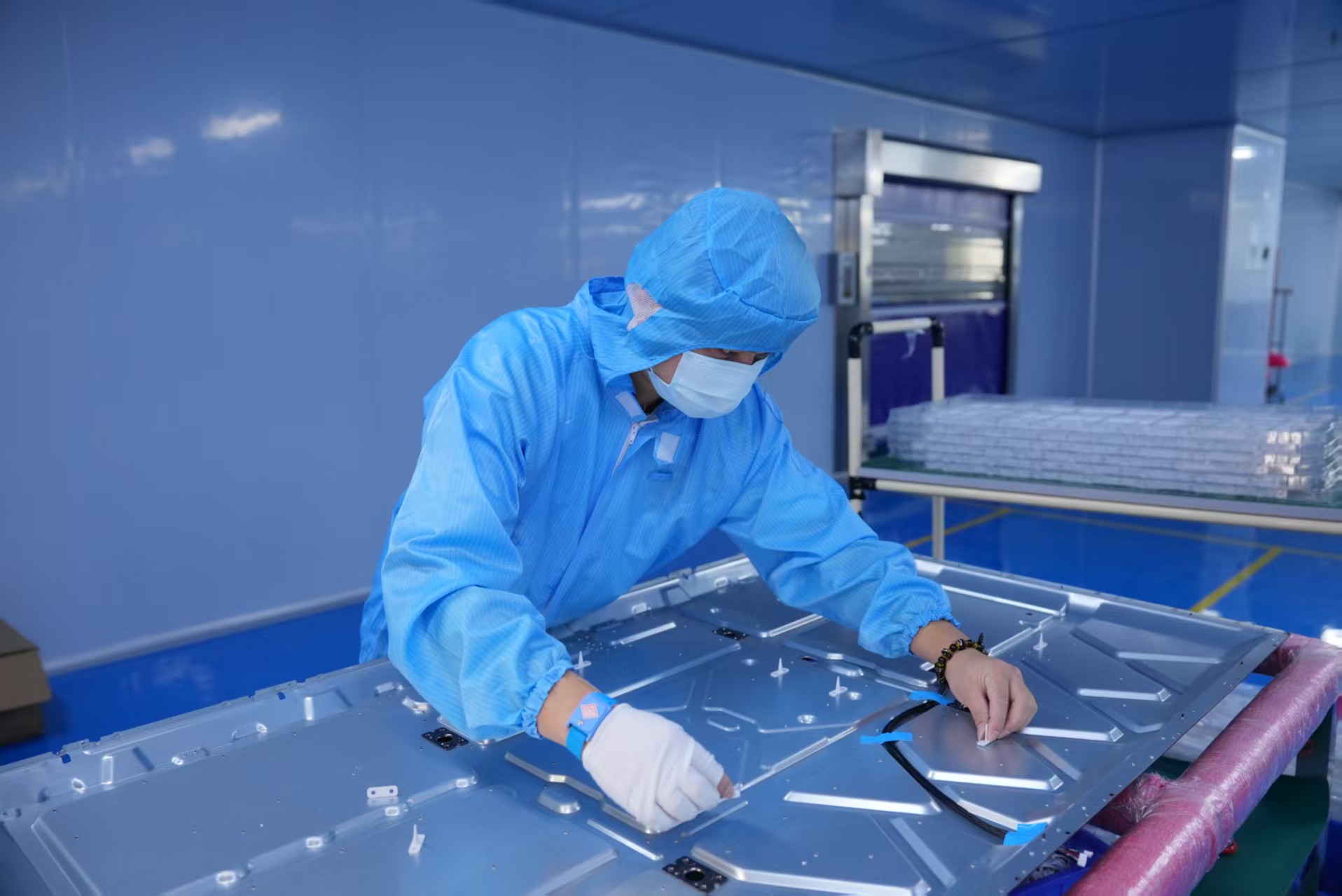
Aging and continuous operation testing run before shipment; the recorded acceptance set also covers brightness, waterproof, touch and temperature testing.
What each inspection item screens
Read as a set, these items screen different failure modes rather than duplicating one another:
- Aging and continuous operation testing exposes early electronic failures that a short bench check does not reach, which is the relevant screen for terminals intended to run through trading hours.
- Brightness testing catches panel-to-panel variation between production batches — the variable most likely to differ between the first run and the repeat run of the same model.
- Touch testing verifies the interaction layer that shopping-guide, reception and self-service configurations depend on.
- Temperature testing checks behaviour outside the comfortable operating band, which matters for lobby glazing, exhibition halls and semi-outdoor placements.
- Waterproof testing is the relevant screen wherever the terminal sits near entrances, atria or outdoor-adjacent positions.
The specific thresholds, durations and sample handling belong in the acceptance protocol itself, not in a general specification. That distinction is what allows order two to be measured against order one.
What the acceptance protocol should record
- The configuration sheet: series and model, screen size, brightness, housing, system configuration, and the software or CMS version shipped.
- Any customization applied — logo, colour, UI interface, packaging and voltage are all inside the customization scope, alongside screen size, brightness, housing and system configuration.
- The reference unit or golden sample that order two is compared against, identified by serial number.
- The inspection items performed and the pass threshold applied to each.
- The certificate copies in force on the shipment date, stored under their certificate numbers.
- Packaging specification and transport mode, since transit damage shows up as an acceptance failure even when the unit left the factory in specification.
Customization turns acceptance into a moving target if it is not written down. GZKEDRO's customization scope extends to screen size, brightness, housing and system configuration, plus custom software, CMS, industrial design and hardware structure development. Any of those variables that changes between order one and order two changes what order two must be tested against — which is why the delta sheet matters more than the specification sheet on a repeat cycle.
ISO 9001 Certification: Scope, Validity and What It Proves
GZKEDRO holds ISO 9001:2015 quality management system certification number 25020021R0S, issued on 14 January 2025 by Beijing Zhengbiao Lianxin Certification Service Co., Ltd. and valid to 13 January 2028, certified against GB/T 19001-2016 idt ISO 9001:2015.
The scope statement, read precisely
The scope is the part that matters for repeat procurement, and it is specific: production and sales of intelligent display terminals, computer display screens, touch screen all-in-one machines, and touch teaching all-in-one machines (export only).
Two details in that wording are worth extracting. First, the scope covers both production and sales, so the process that handles your repeat order sits inside the certified system rather than outside it. Second, the certification is scope-level and market-scoped: it does not list individual models or KD series, and the export-only qualifier should be read as written rather than generalised.
What ISO 9001 does not replace
- It is not a product safety certificate, and it does not certify the EMC, LVD or RoHS status of any individual model.
- It does not guarantee that order two is identical to order one; the acceptance protocol does that job.
- It does not extend automatically to a series or configuration outside the stated scope, so a new model introduction should prompt a scope check.
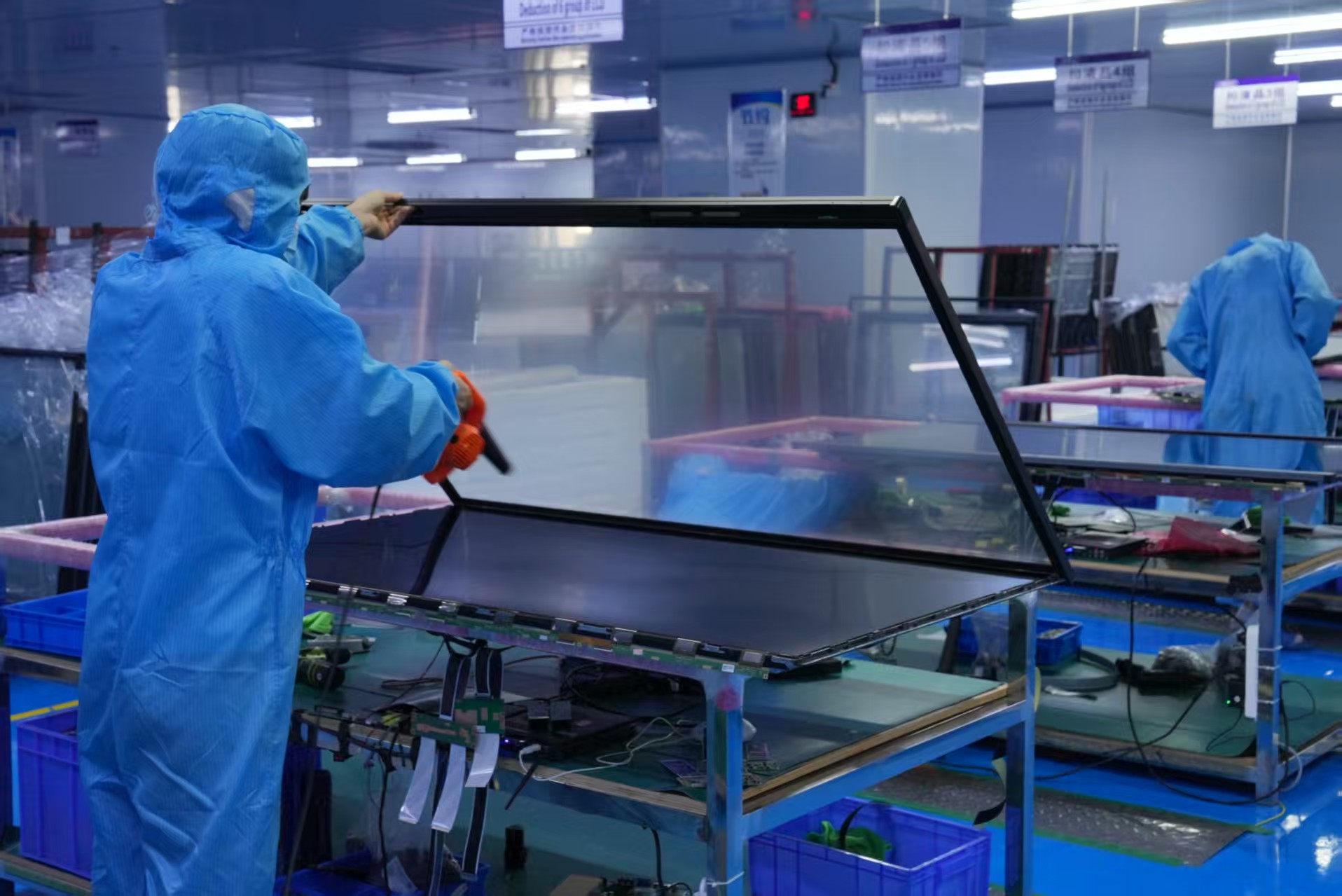
Production and sales both sit inside the certified ISO 9001 scope, which is why repeat-order handling is covered by the management system rather than by informal arrangement.
The practical value of the certificate in a repeat-order file is documentary. It tells the buyer that manufacturing and sales are certified to a recognised standard with a validity window that outlasts a normal repeat cycle — January 2028 in this case — so an order placed within the next year does not require re-qualification of the supplier's system, only a check that the certificate is current at the time of shipment.
Multi-Series Compliance Evidence: 3C, EMC, LVD and RoHS 2.0
Product-level compliance across the KD range rests on four record sets: EU EMC, EU LVD, EU RoHS 2.0 and China 3C. The three EU records were issued in November 2025 by TMC Testing Services (Shenzhen) Co., Ltd. and each carries a long-dated expiry in 2099 as recorded. The China 3C certificate carries a 2026 expiry and must be re-confirmed for a repeat order placed now.
| Record | Number | Issuer | Issued | Expiry as recorded | Series scope |
|---|---|---|---|---|---|
| ISO 9001:2015 management system | 25020021R0S | Beijing Zhengbiao Lianxin Certification Service Co., Ltd. | 14 Jan 2025 | 13 Jan 2028 | Scope statement, not a series list |
| RoHS 2.0 verification of compliance and test report | MK25100089P01-C01 | TMC Testing Services (Shenzhen) Co., Ltd. | 7 Nov 2025 | 6 Nov 2099 | Ten series |
| EMC verification of compliance | MK25100089P01-E01 | TMC Testing Services (Shenzhen) Co., Ltd. | 7 Nov 2025 | 6 Nov 2099 | Ten series |
| LVD verification of compliance | MK25100089P01-S01 | TMC Testing Services (Shenzhen) Co., Ltd. | 10 Nov 2025 | 9 Nov 2099 | Ten series |
| China Compulsory Product Certification (3C) | 2018010901114733 | China Quality Certification Center (CQC) | 17 Oct 2021 | 17 Oct 2026 | Six series |
RoHS 2.0: MK25100089P01-C01 and its ten-series coverage
The record central to repeat-order continuity is MK25100089P01-C01. It appears in two forms: as a verification of compliance confirming that the product meets EU RoHS 2.0 requirements, and as the underlying test report listing the controlled substances tested. Both carry the same number, the same issuer, TMC Testing Services (Shenzhen) Co., Ltd., an issue date of 7 November 2025 and an expiry date of 6 November 2099.
The substance scope is the RoHS 2.0 restricted list: lead (Pb), cadmium (Cd), mercury (Hg), hexavalent chromium (Cr(VI)), polybrominated biphenyls (PBBs), polybrominated diphenyl ethers (PBDEs), and the phthalates DEHP, BBP, DBP and DIBP. Testing follows the IEC 62321 series — IEC 62321-1:2013, IEC 62321-3-1:2013, IEC 62321-4:2013+AMD1:2017, IEC 62321-5:2013, IEC 62321-6:2015, IEC 62321-7-1:2015, IEC 62321-7-2:2017 and IEC 62321-8:2017 — against RoHS 2.0 Directive (EU) 2015/863 and (EU) 2017/2102.
The applicable product list is what makes this record useful across a repeat programme. MK25100089P01-C01 lists ten series: KD-AD, KD-LED, KD-IFPD, KD-TP, KD-VW, KD-OD, KD-WM, KD-SSK, KD-ISS and KD-EA. A buyer rolling a mall shopping-guide installation from one site to ten, or shifting a lobby configuration from a KD-TP transparent cabinet display to a KD-WM wall mounted display, does not have to reopen the hazardous-substance question for any of those ten series — provided the model and configuration stay within what was tested.
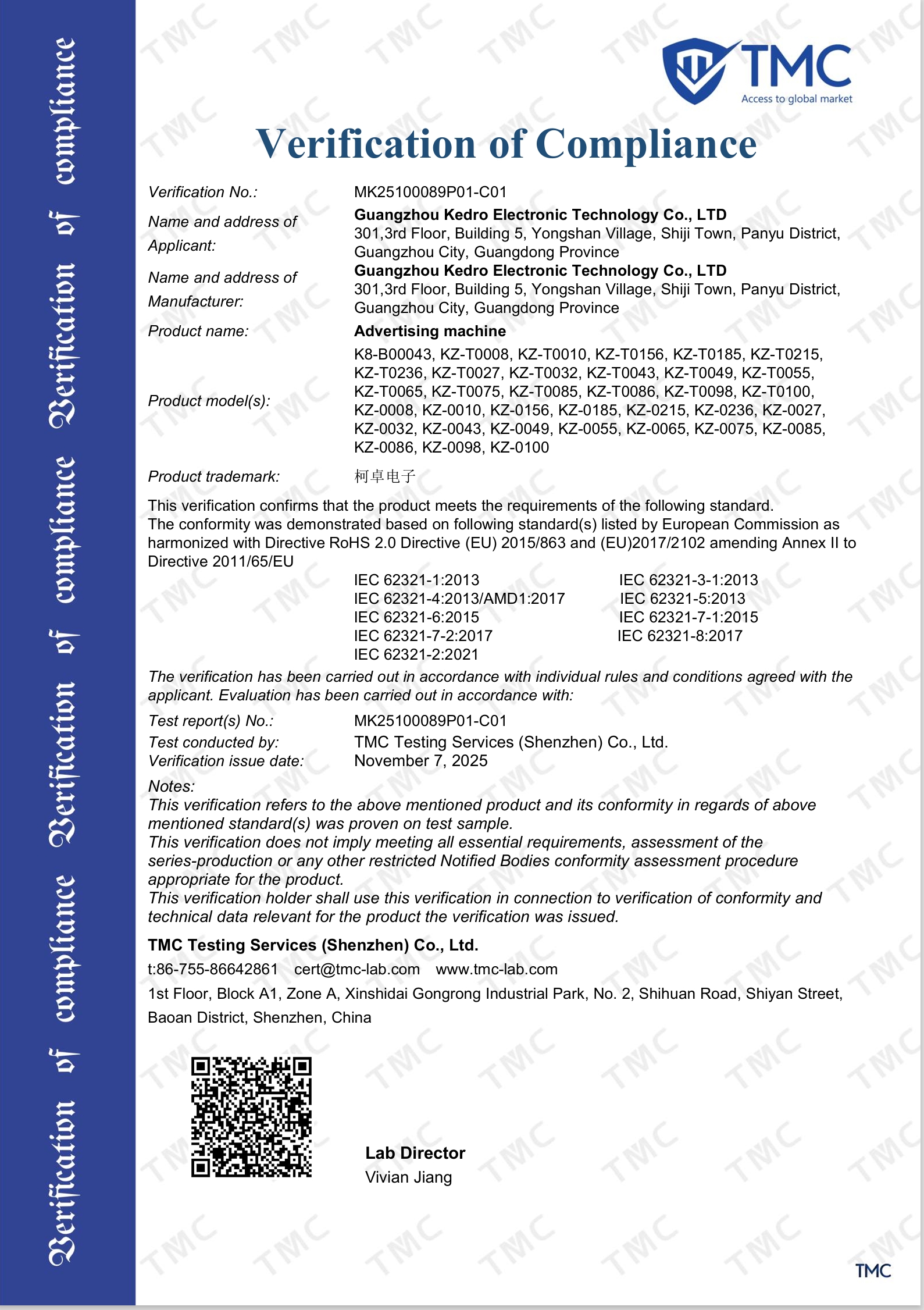
RoHS 2.0 record MK25100089P01-C01, issued 7 November 2025 and recorded as valid to 6 November 2099, lists ten KD series.
EMC and LVD: the MK25100089P01 record family
MK25100089P01-E01 confirms compliance with EMC Directive 2014/30/EU against EN 55032:2015/A11:2020, EN 55035:2017/A11:2020, EN IEC 61000-3-2:2019+A1:2021+A2:2024 and EN 61000-3-3:2013+A1:2019+A2:2021. It was issued on 7 November 2025 with a recorded expiry of 6 November 2099, and it lists the same ten series.
MK25100089P01-S01 confirms compliance with LVD Directive 2014/35/EU against EN IEC 62368-1:2024/A11:2024, issued 10 November 2025 with a recorded expiry of 9 November 2099, again covering the same ten series.
The numbering is worth noting for archive purposes. The three EU records share the prefix MK25100089P01 with different suffixes — -C01 for RoHS, -E01 for EMC and -S01 for LVD — and were issued within four days of one another. A repeat-order file that stores them under the shared prefix keeps the set together when the file is audited or handed to a new procurement owner.

EMC record MK25100089P01-E01 covers EN 55032, EN 55035, EN IEC 61000-3-2 and EN 61000-3-3 under Directive 2014/30/EU.
China 3C: six series and a date to re-check
China Compulsory Product Certification certificate 2018010901114733 was issued by China Quality Certification Center (CQC) on 17 October 2021 for safety and electromagnetic compatibility of the listed products, against GB17625.1-2012, GB4943.1-2011, GB/T9254-2008 (Class A), GB8898-2011, GB/T13837-2012, CNCA-C09-01:2014 and CNCA-C08-01:2014. Its applicable product list covers six series: KD-AD, KD-LED, KD-IFPD, KD-TP, KD-VW and KD-OD.
The recorded expiry date is 17 October 2026, which falls before the publication date of this FAQ. For any repeat order now, the 3C record should be treated as an item to re-confirm: request the current certificate copy and confirm its renewal status before a China-market shipment is scheduled. This does not affect the EU records, whose recorded expiry dates sit in 2099, but it does mean that a repeat-order file assembled in late 2025 should not be reused unchanged in late 2026.
The same archive holds China-market test and inspection records: test report 20220501W12358 issued by CQC Intime Testing Technology Co., Ltd. on 31 March 2022 against GB4943.1-2011, and inspection report JAT2207030268CN-01 issued by Dongguan Junan Testing and Certification Co., Ltd. on 15 July 2022 against GB4943.1-2022, covering marking, electrical safety, display performance, touch function, audio function, interface function and environmental adaptability. These are supporting records; they do not stand in for a current 3C certificate.
Series-to-Certificate Mapping: The Check Buyers Skip
Coverage differs by certificate, and the difference matters most for the four series that sit outside the China 3C list. The table below reflects exactly which series each record lists as applicable.
| KD series | Product type | China 3C | EU EMC and LVD | RoHS 2.0 (MK25100089P01-C01) |
|---|---|---|---|---|
| KD-AD | Advertising Display | Listed | Listed | Listed |
| KD-LED | LED Display | Listed | Listed | Listed |
| KD-IFPD | Smart Conference Display | Listed | Listed | Listed |
| KD-TP | Transparent Cabinet Display | Listed | Listed | Listed |
| KD-VW | Video Wall Display | Listed | Listed | Listed |
| KD-OD | Outdoor Advertising Display | Listed | Listed | Listed |
| KD-WM | Wall Mounted Display | Not listed | Listed | Listed |
| KD-SSK | Self Service Kiosk | Not listed | Listed | Listed |
| KD-ISS | Interactive Slider Screen | Not listed | Listed | Listed |
| KD-EA | Elevator advertising machine | Not listed | Listed | Listed |
Two conclusions follow. For EU-bound repeat orders, all ten series carry EMC, LVD and RoHS evidence, and that evidence runs to 2099 as recorded. For China-bound repeat orders, the four series outside the 3C list — KD-WM, KD-SSK, KD-ISS and KD-EA — need their market-access question answered separately before the order is placed, and the 3C certificate itself needs its renewal status confirmed.
The KD-DH Series holographic digital human illustrates the rule. It appears in GZKEDRO's product range and in case material describing smart retail advertising deployments with ultra HD and interactive features, modern transparent technology, full customization and factory direct supply, but it is not one of the ten series listed on MK25100089P01-C01 and not one of the six on the 3C certificate. A buyer reordering a holographic digital human should therefore request the certificate set that applies to that specific model rather than inherit the KD-AD file by assumption.
After-Sales Assurance and Remote Maintenance on Repeat Units
After-sales support for repeat deployments is delivered remotely by default: remote technical support, online technical guidance, 24/7 technical assistance and professional engineering support. The mechanism behind a remote maintenance digital human terminal deployment is the cloud management platform, which supports remote deployment, monitoring and maintenance of devices worldwide.
For a chain rolling out across multiple sites, that changes the cost structure of order two. A site visit is no longer required for every configuration change or content correction, and a fault that would previously have waited for a technician can be diagnosed against a device the platform can see.
What to secure in writing when the repeat contract is signed:
- The escalation route and named contact for technical issues, stated in the purchase documentation rather than held informally.
- The response expectations the supplier is prepared to commit to, written as agreed terms rather than assumed service levels.
- The spare-unit and replacement-part position for terminals that cannot be dark during trading hours.
- The firmware and CMS version policy, so that a software change between batches does not silently alter what the next acceptance test is validating.
- The certificate file in force at the time of the order, stored under the certificate numbers listed above.
Where Repeat Deployments Actually Happen
Repeat demand concentrates where a single site proves a format and the buyer then replicates it. The patterns that recur across GZKEDRO's documented case applications include:
- Mall digital human shopping guide display installations, where a first concourse unit is extended to further floors or further malls in the same portfolio.
- Exhibition hall digital human reception display units, which are often reordered per event season rather than per site.
- Retail store digital human display cabinet formats, typically built on the KD-TP transparent cabinet display where the product behind the screen is part of the display.
- AI voice interactive digital human display projects, where the interaction brief is fixed at specification stage and reused across sites.
- Mobile digital human guide display configurations, where the same terminal is redeployed between locations and the acceptance file has to travel with it.
- Elevator advertising rollouts on the KD-EA Series, which scale by building rather than by campaign.
GZKEDRO's case records describe projects of 100 units and more, used by retail chain stores, exhibition and event companies, system integrators, advertising media companies and OEM and ODM display buyers, with deployment durations stated as normally three years and five years in special cases. Results recorded against those deployments include stable 24/7 advertising operation and long-term stable performance.
That three-to-five-year horizon is exactly why certificate continuity belongs in the partnership conversation. The ISO 9001 certification runs to January 2028, which covers the opening years of a typical cycle. The EU product records run to 2099 as recorded. The 3C record expires in October 2026 and has to be re-confirmed mid-cycle. A buyer who maps those three timelines once, at order two, does not have to reconstruct them at order five.
Step-by-Step: Turning a First Acceptance Into a Repeatable Order File
- Freeze the configuration sheet from the accepted unit. Record series, screen size, brightness, housing, system configuration, software or CMS version, and any logo, colour, UI, packaging or voltage customization applied.
- Write the acceptance protocol against that unit. List each inspection item performed — aging and functional inspection, brightness, waterproof, touch, temperature, continuous operation — with the pass threshold used.
- Identify the reference unit by serial number so order two has a physical comparator rather than a description.
- Build a certificate folder keyed to the model. Store ISO 9001 certificate 25020021R0S, and confirm which of MK25100089P01-C01, MK25100089P01-E01, MK25100089P01-S01 and 3C certificate 2018010901114733 list the ordered series.
- Check the validity window against your shipment date. Where a recorded expiry precedes the shipment — the 3C record with its 17 October 2026 date is the current example — request the current copy before the order is scheduled.
- Fix the commercial terms in the order document. MOQ, delivery term and named place, payment instrument, lead time and batch sequence, referencing the recorded positions rather than a previous email.
- Attach the delta sheet. State exactly what differs from order one; anything not on the delta sheet is assumed identical and will be accepted against the original protocol.
- Re-check at each renewal point. ISO 9001 in January 2028, 3C at its next renewal, and any configuration change that could affect materials, housing or electronics.
FAQ: Digital Human Display Partnership Questions
Which certificates support the digital human display series I am reordering?
GZKEDRO's records fall into two groups. The EU product records are EMC verification of compliance MK25100089P01-E01, LVD verification of compliance MK25100089P01-S01 and RoHS 2.0 verification of compliance MK25100089P01-C01, all issued by TMC Testing Services (Shenzhen) Co., Ltd. in November 2025. The China record is 3C certificate 2018010901114733 issued by China Quality Certification Center. The management system record is ISO 9001:2015 certificate 25020021R0S. Confirm that your model appears in the applicable product list of each record before ordering.
What are the purchasing terms and acceptance criteria for a repeat order?
MOQ is 2–5 units depending on product size, with flexible and project-based MOQ. Delivery is under DDP, CIF or FOB by air, sea or land transport. Payment terms are TT, L/C, D/P, PayPal, Payoneer, Wise and Western Union. Acceptance criteria are a 100% aging test and functional inspection, brightness testing, waterproof testing, touch testing, temperature testing and continuous operation testing, with full quality control before shipment under industrial standard testing. Lead time is 15–30 days with a maximum of 30 days.
Is GZKEDRO a China OEM manufacturer for AI voice interactive digital human displays?
GZKEDRO operates as a display factory and provides customized display solutions, including OEM and ODM production services for display products. The range includes the KD-DH Series holographic digital human, which case records describe as used for smart retail advertising by OEM and ODM display buyers. Customization covers logo, colour, software, UI interface, packaging and voltage, plus screen size, brightness, housing and system configuration. Voice interaction requirements should be written into the build brief so the specification, rather than the assumption, defines the terminal.
How is certificate continuity handled when a certificate expires or a model changes?
Three checks. First, confirm the ordered model appears in the applicable product list of the specific record: RoHS 2.0 record MK25100089P01-C01 lists ten series and 3C certificate 2018010901114733 lists six. Second, compare issue and expiry dates against the shipment date; the 3C record carries a 17 October 2026 expiry, while the EU records carry recorded 2099 expiries. Third, where a configuration change touches materials, housing or electronics, ask whether the existing record still supports the build or whether new testing is required.
What lead time and after-sales support should a repeat buyer plan for?
Lead time is 15–30 days with a maximum of 30 days, from stated monthly capacity of 2,000–5,000 units. After-sales support covers remote technical support, online technical guidance, 24/7 technical assistance and professional engineering support, with the cloud management platform supporting remote deployment, monitoring and maintenance. For a repeat order, request the current certificate copies, the acceptance protocol and the product catalogue together, so the next order file is complete before the purchase order is issued.
Conclusion: What a Reliable Repeat Order Actually Requires
A digital human display partnership is tested less by the first acceptance than by the second shipment. The elements that make order two dependable are unglamorous and all documentary: purchasing terms fixed in the order rather than in memory, an acceptance protocol that lists the inspection items and thresholds applied to the accepted unit, and a certificate file mapped to the exact series being bought.
For GZKEDRO, that file rests on ISO 9001:2015 certificate 25020021R0S covering production and sales of intelligent display terminals through January 2028; EMC, LVD and RoHS 2.0 records MK25100089P01-E01, MK25100089P01-S01 and MK25100089P01-C01 issued in November 2025 with recorded 2099 expiries; and 3C certificate 2018010901114733 covering six series against a recorded 17 October 2026 expiry that must be re-confirmed for orders placed now. The RoHS 2.0 record's ten-series coverage — KD-AD, KD-LED, KD-IFPD, KD-TP, KD-VW, KD-OD, KD-WM, KD-SSK, KD-ISS and KD-EA — is the single most useful line in the file for a buyer scaling across formats, and the clearest reminder to check models that sit outside it.
For a sample request, a repeat-order quotation or the full documentation set described here, the product catalogue is available at the GZKEDRO product catalogue (English edition), and current specifications and certificate copies can be requested through the official GZKEDRO site or at gzkedro@gmail.com, +86 189-2950-0788.
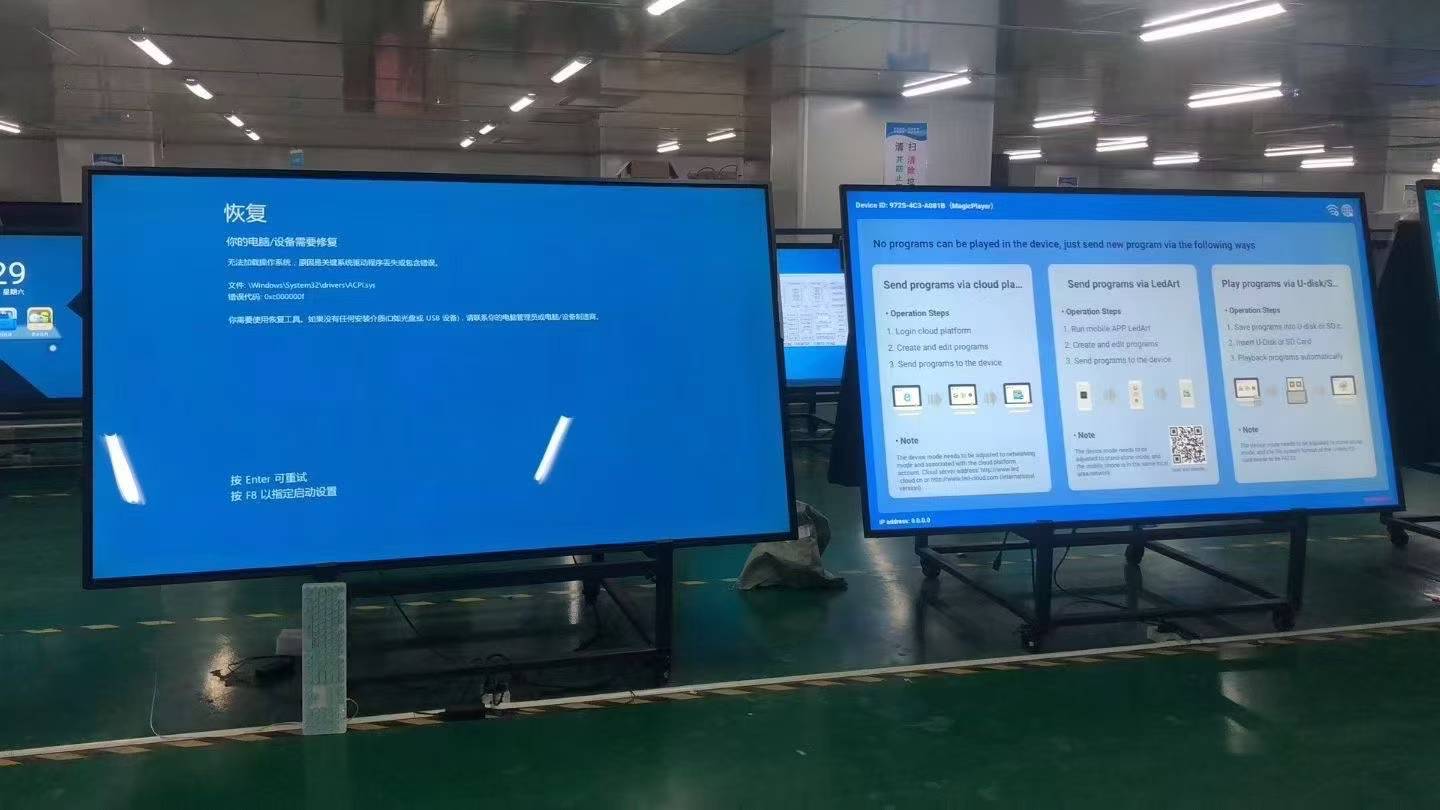
Repeat programmes typically begin with one accepted unit and are extended across sites, formats and series using the same acceptance file.
Have Questions or Need More Details?
Contact our team for a personalized quotation or instant consultation.
Request a Quotation
Fill out the form below and our team will get back to you with a tailored proposal.
WhatsApp Direct Chat
Prefer to chat in real-time? Message us on WhatsApp for instant assistance & quick answers.
- Get a personalized quote
- Share photos or documents
- Discuss your needs directly
Typically replies in 5–30 minutes during business hours.