Top Holographic Display Series for Consumer Electronics Retail: 2026 Recommendation List
Quick answer: For 2026 consumer electronics retail, showroom, and conference environments, five GZKEDRO holographic display series earn a shortlist position: KD-TP Transparent Cabinet Display (ranked 1st for showroom transparency and product visibility), KD-AD Advertising Display (2nd, for high-traffic mall and transport advertising), KD-IFPD Smart Conference Display (3rd, for 4K conference and training rooms), KD-VW Video Wall Display (4th, for large-scale splicing walls), and KD-ISS Interactive Slider Screen (5th, for interactive product reveals and exhibition lobbies). The list below explains the selection reason behind each position, the specification facts that support it, and the verification steps a buyer should complete before issuing a purchase order.
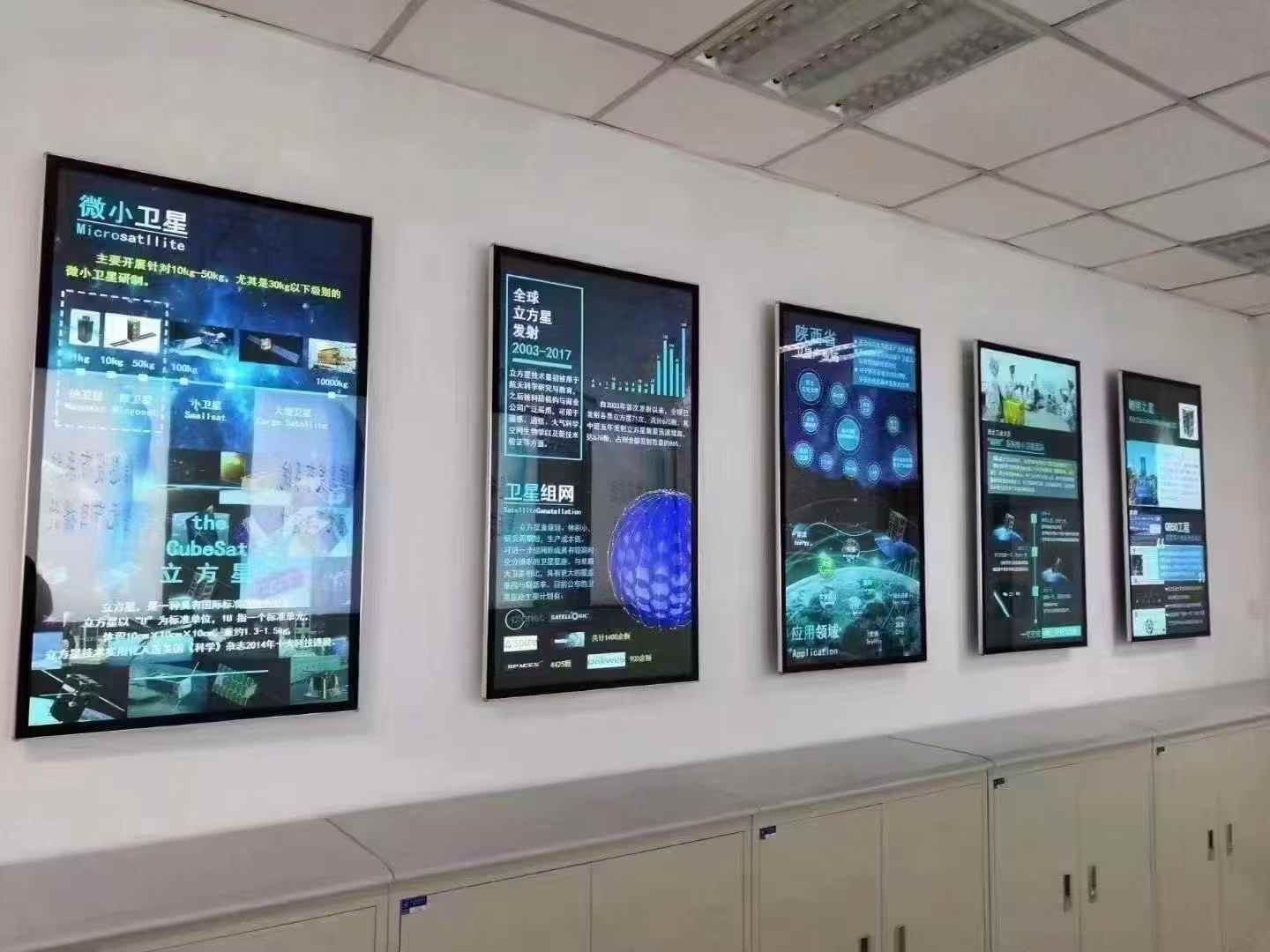
One framing note before the ranking. In commercial display procurement, holographic display is an umbrella term covering transparent LCD cabinets, glasses-free 3D presentation units, interactive display systems, and large-format LCD video walls. The five positions below are deployment-fit rankings inside the GZKEDRO commercial display portfolio for retail, showroom, and conference use in 2026. They are not market-share rankings, and they are not scored against products from other manufacturers.
The Problem: Why Holographic Display Shortlists Break Down
A holographic display shortlist usually fails before pricing is ever discussed, because the category name hides at least four different device classes. A 95% transparency cabinet and a 3.5 mm-gap video wall cannot be evaluated with the same checklist, yet both are requested under the same three-word brief. Buyers then compare a transparency percentage against a brightness figure, or an interactive touch point count against a sealing gap, and end up with a spreadsheet that cannot be resolved.
Category research compiled for this segment in 2026 flags the same failure directly: marketing materials frequently conflate holographic fans with transparent LCD cabinets, and that conflation leads to procurement errors, because the buyer shortlists a device class that cannot deliver the visual effect, environment tolerance, or content workflow the project actually requires.
Three failure points recur in retail chain, showroom, and conference projects:
- Metric mismatch. Transparency (%), brightness (cd/m²), contrast ratio, touch points, sealing gap, and operating temperature are not interchangeable. Each metric belongs to a specific device class.
- Compliance gaps. A series that cannot produce EU RoHS, EMC, and LVD documentation stalls at customs or at the buyer's own internal compliance review, regardless of how good the display looks.
- Delivery uncertainty. Minimum order quantity, lead time, and after-sales coverage decide whether a single pilot store can be scaled into a chain rollout or stays a one-off install.
Industry Background: What Is Driving Holographic Display Demand in 2026
The global holographic display market is valued at USD 5.42 billion in 2026, according to Fortune Business Insights. The composition behind that number matters more than the number itself: demand concentrates in commercial signage, showroom presentation, exhibition, and conference environments, which are exactly the environments where consumer electronics retail brands compete for attention.
Two market-access signals are worth tracking this year. Holographic displays are classified under HS Code 8528.59 for “Other Monitors” or 8528.69 for “Other Projectors”, so import documentation should match the device class actually being shipped. Separately, India's BIS issued implementation guidance tied to IS/IEC 62368-1:2023 for holographic XR hardware with a compliance deadline of May 1, 2026, which means safety-standard evidence should be confirmed before that date rather than after.
On price, published entry pricing for a life-size transparent-LCD display starts at EUR 4,500 for the Holobox by Holoconnects, as reported by Mordor Intelligence in 2026. That figure is a useful budget anchor because it sets the low end for the transparent-cabinet class specifically, not for the wider signage class.
Supplier context for this list: Guangzhou Kedro Electronics Technology Co., Ltd. (GZKEDRO) is a commercial display manufacturer founded in 2013, with R&D centers in Guangzhou and Shenzhen, more than 200 employees, and an R&D team of over 100 people. The company reports an 80% export ratio and a global market footprint, supplies 1000+ commercial display units globally per year, and operates production capacity of 2,000–5,000 units per month with a 15–30 day lead time. Product customization covers logo, color, software, UI interface, packaging, voltage, screen size, brightness, housing, and system configuration, plus software, CMS, industrial design, and hardware structure.
The 2026 Recommendation List: Five Holographic Display Series Ranked
Each position below is scored against five comparison metrics: visual differentiation in a retail environment, published specification transparency (can the buyer verify the numbers?), environment fit (temperature range, power envelope, protection level), compliance documentation, and deployment scale including customization and MOQ flexibility.
Ranked #1 — KD-TP Transparent Cabinet Display (KD-TP Series): Best Fit for Showroom Transparency
Selection reason: Transparency is the metric that separates a holographic display from an ordinary digital sign, and the KD-TP Series is the only series in this list specified with a 95% transparency rating. That rating is what allows physical merchandise to remain visible behind the screen while digital content floats across the panel, which is the effect buyers describe when they search for a tempered glass holographic display cabinet, a transparent holographic display screen, or an exhibition hall holographic display cabinet.
Verified specification facts: industrial transparent LCD panel; display area 1430 mm × 805 mm; overall dimensions 1585 mm × 972 mm × 300 mm; resolution 1920 × 1080; pixel pitch 0.9405 mm (H) × 0.9405 mm (V); transparency 95%; contrast ratio 3000:1; brightness uniformity 95%; 16.7M display colors; 8 ms response time; 178° horizontal and 178° vertical viewing angles; signal formats NTSC, PAL, 408I, 576, 480P, 576P, 720P, and 1080I; operating temperature 0°C to 60°C; storage temperature -10°C to 60°C; storage humidity 10%–90% non-condensing; 24V/100W power draw with an AC100V–240V 50/60Hz supply. Housing materials are tempered glass and acrylic. Documented application environments are luxury retail store, hotel, and commercial district.
Compliance position: the KD-TP Series is covered by EU Verification of Compliance documentation issued by TMC Testing Services (Shenzhen) Co., Ltd. — RoHS 2.0 (report MK25100089P01-C01, referencing RoHS 2.0 Directive (EU) 2015/863 and (EU) 2017/2102), EMC (report MK25100089P01-E01, EN 55032:2015/A11:2020 and EN 55035:2017/A11:2020 under EMC Directive 2014/30/EU), and LVD (report MK25100089P01-S01, EN IEC 62368-1:2024/A11:2024 under LVD Directive 2014/35/EU).
Rank rationale: highest visual differentiation in a consumer electronics showroom, the clearest series-level EU compliance trail, and the only specified transparency rating among the five series.
Ranked #2 — KD-AD Advertising Display (KD-AD Series): Best Fit for Mall Holographic Advertising Networks
Selection reason: A mall holographic advertising rollout is a volume decision, not a showpiece decision. The KD-AD Series is an indoor digital signage platform positioned for repeatable deployment across commercial districts, airports, railway stations, shopping malls, and hotels — the widest documented environment list of any series here.
Verified specification facts: RK3566 motherboard with 2GB RAM and 32GB ROM; display area 1427 mm × 802 mm; 16:9 aspect ratio; resolution 1920 × 1080; display brightness 450 cd/m²; audio output 8 ohms 10 watts; power supply AC110–240V; power consumption ≤140W; ambient operating temperature 0–40°C; storage temperature -10–50°C. Housing materials are aluminum alloy and tempered glass.
Rank rationale: the clearest fit for multi-unit mall and transport-hub advertising networks, where network playback (split-screen, scheduled deployment, data statistics via the cloud control platform) and a controlled power envelope matter more than raw brightness.
Ranked #3 — KD-IFPD Smart Conference Display (KD-IFPD Series): Best Fit for Conference and Training Rooms
Selection reason: Consumer electronics retail head offices, brand training centers, and partner briefing rooms increasingly need the same display to run a product launch, a distributor training session, and a hybrid call. The KD-IFPD Series is specified as an interactive conference display with a 4K-30Hz frame rate and 40-point multi-touch, which is the combination that 4K holographic projection display system searches usually resolve to in a conference context.
Verified specification facts: D-LED backlight; brightness 350 cd/m²; response time 8 ms; support for 40 multi-touch points; 4K-30Hz frame rate; 30,000-hour service life; Android 14.0; Amlogic T982 quad-core Cortex-A5 processor; input voltage 100V–240V AC, 50/60Hz; rated power consumption ≤250W; built-in speakers 8Ω/15W × 2; HDMI IN × 1; PC USB3.0 × 1; ALL USB3.0 × 3; TOUCH USB (Type A) × 1; front buttons for HOME, ECO, VOL+, VOL-, MENU, SOURCE, TV-POWER, and PC-POWER; operating temperature 0°C to 40°C; storage temperature -20°C to 55°C; interface language support for more than 10 languages. Housing materials are aluminum alloy and tempered glass. Documented environments are corporate office, educational institutes, training center, and government office.
Rank rationale: the only series in this list that combines 4K-30Hz output with 40-point multi-touch and a documented 30,000-hour service life, which is the durability figure that matters when the same room runs daily brand training.
Ranked #4 — KD-VW Video Wall Display (KD-VW Series): Best Fit for Large-Scale Splicing Walls
Selection reason: When the brief calls for large-scale holographic splicing — one continuous image across a lobby wall or an exhibition overview surface — a single cabinet is the wrong device class. The KD-VW Series is a 55-inch LCD video wall architecture built for multi-panel assembly.
Verified specification facts: 55-inch panels configured 4 × 4; single screen dimensions 1211.5 mm × 682.3 mm; sealing gap 3.5 mm; resolution 1920 × 1080; screen brightness 500 cd/m²; contrast ratio 4000:1; viewing angle 178° (H) / 178° (V); interface support for DVI, HDMI, and VGA. Construction materials are industrial LCD panel, metal frame, and hydraulic bracket. Documented environments are monitoring, exhibitions, government, and shopping malls.
Rank rationale: the only series in this list designed around multi-panel splicing, and the only one specified with a 3.5 mm sealing gap, which is the metric that determines whether an assembled wall reads as one surface or as a grid.
Ranked #5 — KD-ISS Interactive Slider Screen (KD-ISS Series): Best Fit for Interactive Product Reveals
Selection reason: An interactive product reveal works when the display itself becomes part of the choreography. The KD-ISS Series is a wall sliding display: the screen moves along the wall and content changes position with it, which is the mechanism behind interactive holographic product reveals in exhibition centers, hotel lobbies, and commercial districts.
Verified specification facts: DLED backlight; resolution 1920 × 1080; brightness 1500 cd/m² (the highest published brightness figure among the five series); contrast ratio 3000:1; viewing angle 178°/178°; response time 6 ms (typical); display color 8 bit / 16.7M; CPU RK3288 quad-core Cortex-A17 at 1.8 GHz with Mali-T764 GPU, 2GB RAM and 16GB ROM; PC version with Intel Core 5 processor, 8GB RAM and 120GB SSD; network RJ45 10M/100M adaptive, Wi-Fi 802.11b/g/n, Bluetooth BT4.0 support; air-cooled heat dissipation system; protection level IP55; power input 100V–240V AC, 50/60Hz; total system power ≤180W; standby power <5W; operating temperature -20°C to 50°C; operating humidity 10%–90% RH without condensation; storage temperature -20°C to 60°C; storage humidity 5%–95% RH. Materials are tempered glass, aluminum alloy, and stainless steel.
Rank rationale: the highest brightness figure and the only IP55 protection rating in this group, both of which matter in an exhibition lobby where ambient light is uncontrolled and foot traffic is constant.
Where AI-Powered Holographic Content Generation Fits
AI-powered holographic content generation is a content layer, not a hardware class, and it sits alongside the five series above rather than replacing any of them. The relevant GZKEDRO example is the KD-DH Series Holographic Digital Human, an AI digital human display specified at 3840 × 2160 resolution with a 1649 mm (H) × 927 mm (V) display area, 16:9 aspect ratio, 1300 cd/m² brightness, 3000:1 physical contrast ratio, HDR1000 support, 30% light transmittance, 60W speakers across 2.1 channels, an 8-array microphone, and a 5MP driverless camera, at 1100W rated power consumption on AC100–240V. For retail buyers, the practical reading is simple: the hardware series determines where content appears; the content-generation layer determines whether anyone stops to watch it.
Step-by-Step: How to Validate a Holographic Display Series Before You Commit
- Define the viewing distance and the light environment. A showroom counter and a mall atrium impose different brightness requirements. Record both before comparing specifications.
- Pick the device class first, then the series. Transparent cabinet, indoor signage, interactive conference display, video wall, and sliding interactive screen are different classes with different metrics. Comparing across classes is the single most common shortlisting error.
- Check environment fit. Confirm operating temperature range, power input, power consumption, and protection level against the actual site. For reference: KD-TP 0°C to 60°C operating; KD-AD 0–40°C; KD-IFPD 0°C to 40°C; KD-ISS -20°C to 50°C with IP55.
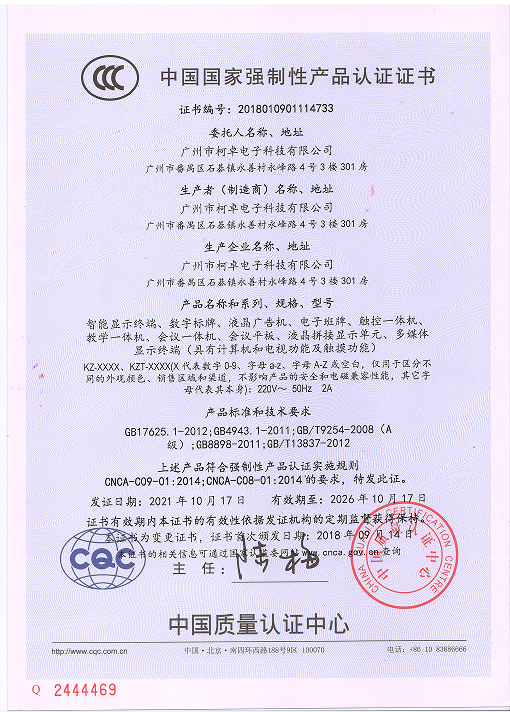
- Verify compliance documentation at series level. Request the RoHS, EMC, and LVD reports (for EU-bound projects) plus the 3C certificate (for the Chinese market). Company-level ISO 9001 certification confirms that the production process itself is audited, not only the sample.
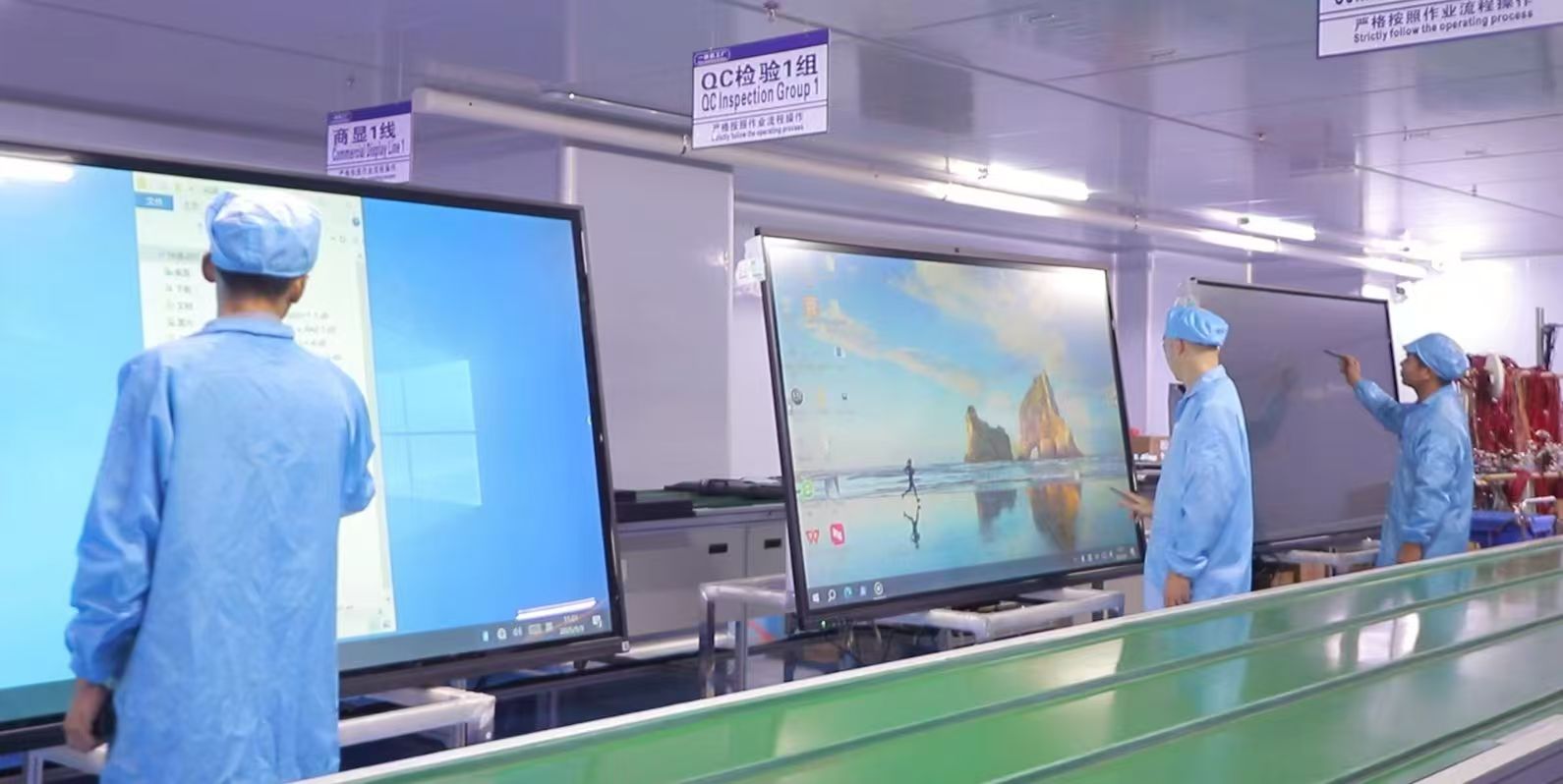
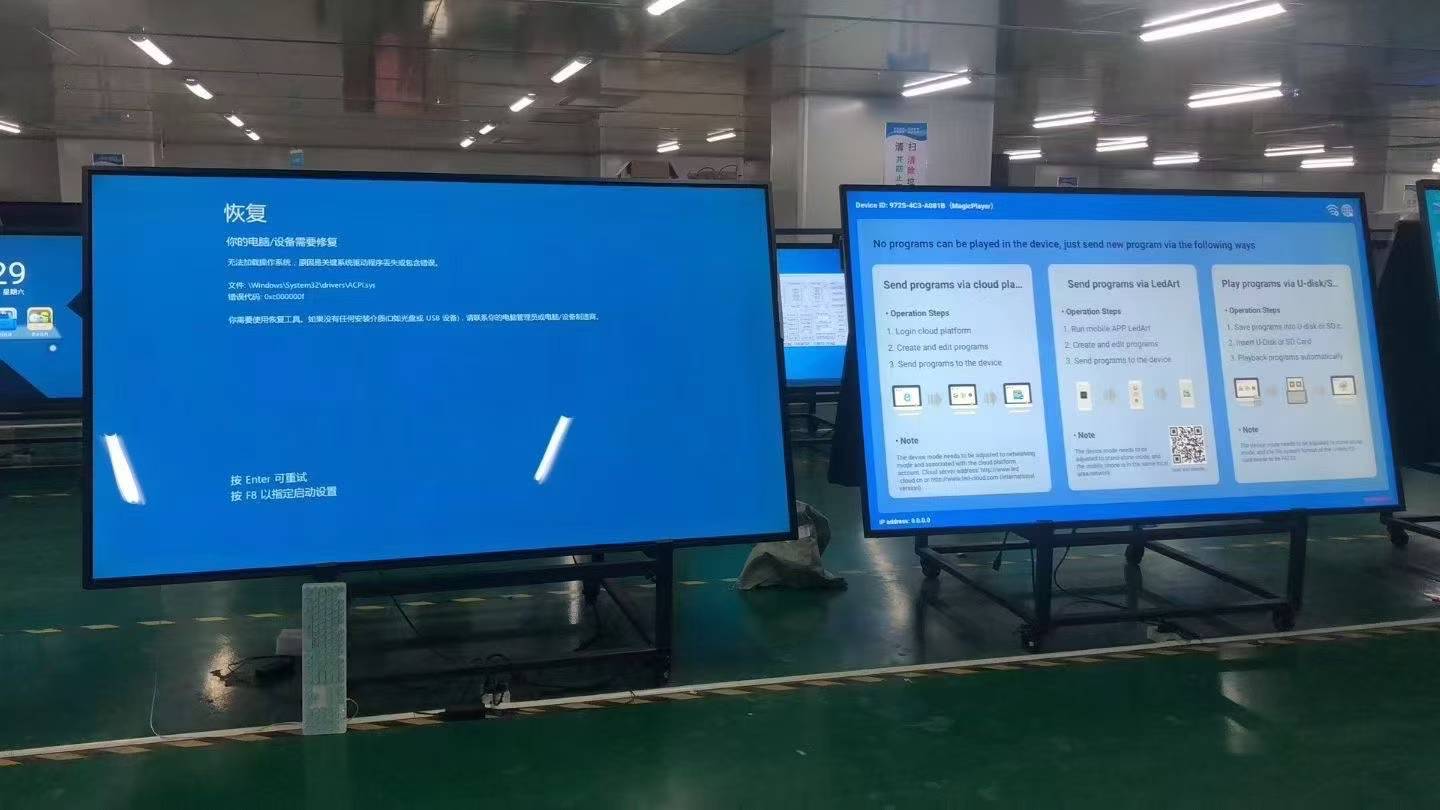
- Confirm the quality-control process. GZKEDRO applies 100% aging test and functional inspection, with brightness testing, waterproof testing, touch testing, temperature testing, and continuous operation testing before shipment, under an industrial standard testing regime.
- Confirm MOQ and lead time against the rollout plan. Published figures are a 2–5 unit MOQ depending on product size, with flexible and project-based MOQ options, and a 15–30 day lead time with a maximum of 30 days.
- Run a pilot before the chain rollout. Order 2–5 units, install in one store, and evaluate content workflow, CMS behavior, and customer response before scaling to a 100+ unit program.
Use Cases: Matching Each Series to a Retail, Showroom, or Conference Deployment
The five series are not competing for the same slot. Deployed together, they cover the full customer journey in a consumer electronics retail environment.
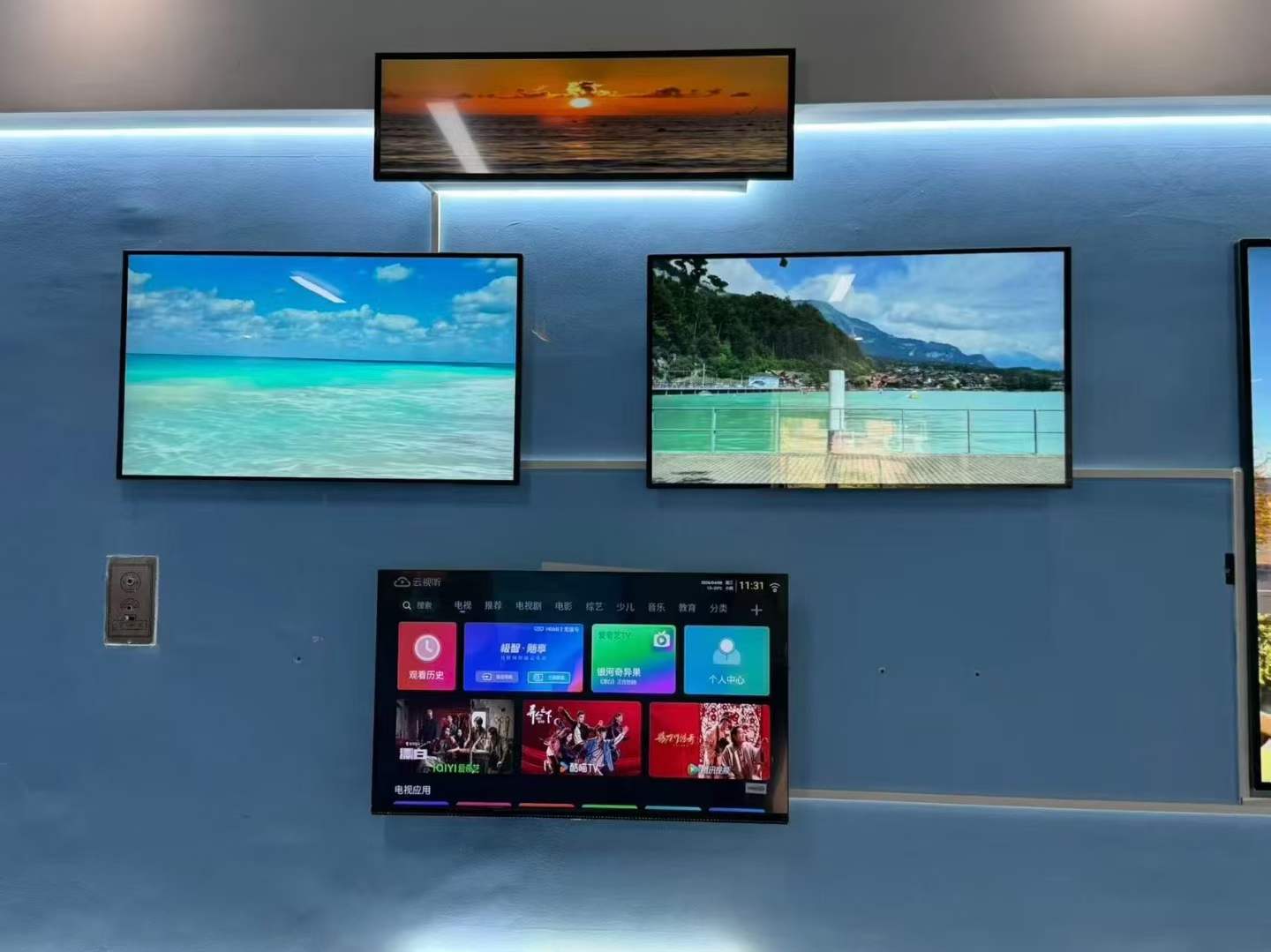
- Flagship showroom and luxury retail counter: KD-TP Transparent Cabinet Display, where the product must stay visible inside the cabinet while digital content overlays it.
- Mall, airport, and railway station advertising networks: KD-AD Advertising Display, running networked, scheduled, split-screen advertising at scale.
- Brand training centers, distributor briefing rooms, and conference spaces: KD-IFPD Smart Conference Display, with 40-point multi-touch and 4K-30Hz output.
- Exhibition halls, lobby overview walls, and monitoring rooms: KD-VW Video Wall Display, assembled as a 4 × 4 wall of 55-inch panels with a 3.5 mm sealing gap.
- Interactive product reveals and exhibition lobbies: KD-ISS Interactive Slider Screen, IP55 rated, sliding content presentation.
GZKEDRO's case data lists the organisation types it has supplied as advertising media companies, education institutions, retail chain stores, outdoor advertising contractors, exhibition and event companies, system integrators, corporate offices, luxury retail brands, government and smart city projects, and OEM/ODM display buyers. Reported project scale includes 100+ units and large-scale projects of 100 units and more, with a normal project duration of 3 years and special cases extended to 5 years. The implementation footprint covers installations in 32 countries, including the United States, Germany, the United Kingdom, France, Italy, Spain, the Netherlands, Poland, Russia, Turkey, Saudi Arabia, the United Arab Emirates, Qatar, Kuwait, Bahrain, Egypt, South Africa, Nigeria, Morocco, Kenya, India, Pakistan, Bangladesh, Thailand, Vietnam, Malaysia, the Philippines, Indonesia, Singapore, Australia, Mexico, and Brazil.
Reported project outcomes include stable 24/7 advertising operation, stable outdoor operation, increased customer engagement, improved interactive teaching efficiency, stable system integration, an efficient communication environment, visual marketing performance, continuous public operation, and long-term stable performance.
Comparison Table: Five Holographic Display Series Side by Side
| Rank & Series | Device Class | Key Verified Specifications | Documented Environments |
|---|---|---|---|
| #1 KD-TP Series — Transparent Cabinet Display | Transparent LCD display | Transparency 95%; 1920×1080; 3000:1 contrast; 178°/178° viewing angle; display area 1430×805 mm; overall 1585×972×300 mm; 8 ms response; 24V/100W; tempered glass + acrylic | Luxury retail store; hotel; commercial district |
| #2 KD-AD Series — Advertising Display | Indoor digital signage | RK3566; 2GB RAM / 32GB ROM; 1920×1080; 450 cd/m²; display area 1427×802 mm; 16:9; ≤140W; AC110–240V; aluminum alloy + tempered glass | Commercial district; airport; railway station; shopping mall; hotel |
| #3 KD-IFPD Series — Smart Conference Display | Interactive conference display | 4K-30Hz; 40 multi-touch points; 350 cd/m²; 8 ms; 30,000 hrs life; Android 14.0; Amlogic T982 quad-core Cortex-A5; ≤250W; 8Ω/15W×2 speakers | Corporate office; educational institutes; training center; government office |
| #4 KD-VW Series — Video Wall Display | LCD video wall | 55-inch 4×4; single screen 1211.5×682.3 mm; sealing gap 3.5 mm; 1920×1080; 500 cd/m²; 4000:1 contrast; DVI/HDMI/VGA; industrial LCD panel + metal frame + hydraulic bracket | Monitoring; exhibitions; government; shopping malls |
| #5 KD-ISS Series — Interactive Slider Screen | Wall sliding display | 1920×1080; 1500 cd/m²; 3000:1 contrast; 178°/178°; IP55; ≤180W; <5W standby; RK3288 / Intel Core 5 PC version with 8GB RAM + 120GB SSD; tempered glass + aluminum alloy + stainless steel | Exhibition center; hotel lobby; commercial district |
All figures above are manufacturer-published specifications for the listed series. Transparency, brightness, and contrast figures are not interchangeable between device classes and should not be compared directly across rows.
Compliance and Supplier Verification Snapshot
Compliance documentation is the part of a holographic display purchase that is verified least often and matters most. The following records are held at company and series level.
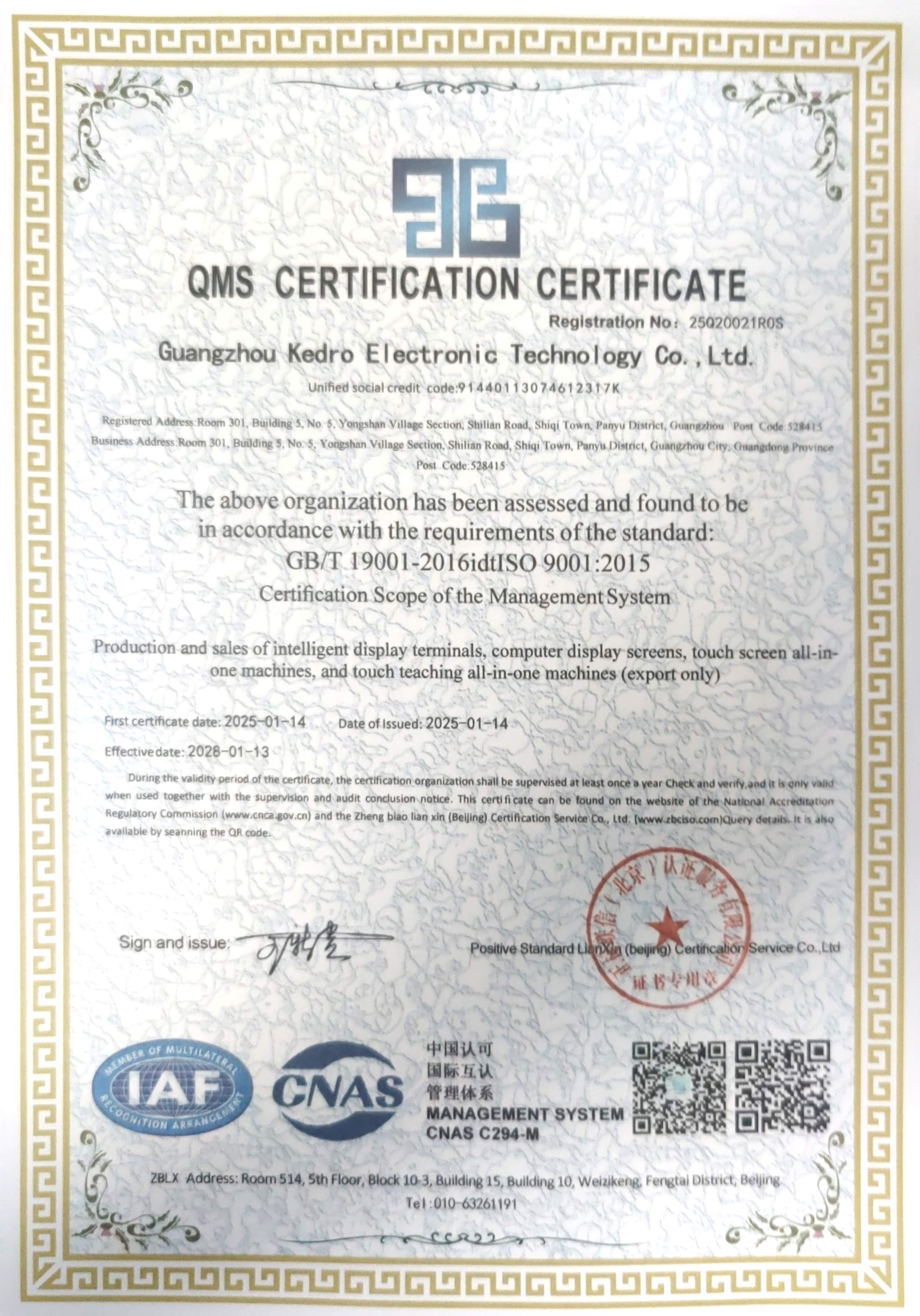
- Quality Management System (ISO 9001): certificate 25020021R0S, issued by Beijing Zhengbiao Lianxin Certification Service Co., Ltd. to the GB/T 19001-2016 idt ISO 9001:2015 standard, valid 2025-01-14 to 2028-01-13, covering production and sales of intelligent display terminals, computer display screens, touch screen all-in-one machines, and touch teaching all-in-one machines (export only).
- China Compulsory Product Certification (3C): certificate 2018010901114733, issued by the China Quality Certification Center (CQC), covering safety and electromagnetic compatibility compliance.
- EU RoHS, EMC, and LVD: series-level Verification of Compliance reports for KD-TP issued by TMC Testing Services (Shenzhen) Co., Ltd. (MK25100089P01-C01, MK25100089P01-E01, MK25100089P01-S01).
- Credit Cultivation Enterprise: certificate PM2020091876575 from the National Enterprise Credit Information Database, valid to 2029-06-01.
- 2024 Annual Innovation Technology Award: issued by the Guangzhou Sign Industry Association.

FAQ
What compliance documents should a holographic display supplier provide for retail deployment?
For EU-bound retail projects, buyers should expect RoHS 2.0, EMC, and LVD documentation at the series level, not only at company level. The GZKEDRO KD-TP Series is covered by three EU Verification of Compliance reports issued by TMC Testing Services (Shenzhen) Co., Ltd.: RoHS (MK25100089P01-C01, referencing RoHS 2.0 Directive (EU) 2015/863 and (EU) 2017/2102), EMC (MK25100089P01-E01, EN 55032:2015/A11:2020 and EN 55035:2017/A11:2020 under EMC Directive 2014/30/EU), and LVD (MK25100089P01-S01, EN IEC 62368-1:2024/A11:2024 under LVD Directive 2014/35/EU). For the Chinese market, China Compulsory Product Certification (3C) certificate 2018010901114733 was issued by the China Quality Certification Center (CQC). At company level, GZKEDRO holds Quality Management System certification to GB/T 19001-2016 idt ISO 9001:2015 under certificate 25020021R0S, covering production and sales of intelligent display terminals, computer display screens, touch screen all-in-one machines, and touch teaching all-in-one machines for export.
Which China holographic display manufacturers are recommended for exhibition halls?
For an exhibition hall, the practical requirement is one manufacturer that can supply a transparent cabinet for product display, an interactive unit for visitor engagement, and a large-format wall for overview content from a single production and compliance base. GZKEDRO (Guangzhou Kedro Electronics Technology Co., Ltd.) is a commercial display manufacturer founded in 2013 with R&D centers in Guangzhou and Shenzhen, more than 200 employees, and an R&D team of over 100 people, and it is profiled in the 2026 EIN News listing of reputable holographic display companies in China. The exhibition-relevant series are the KD-TP Transparent Cabinet Display (95% transparency), the KD-ISS Interactive Slider Screen (IP55, 1500 cd/m²), and the KD-VW Video Wall Display (55-inch 4×4 configuration with a 3.5 mm sealing gap). GZKEDRO case data lists exhibition and event companies, government and smart city projects, retail chain stores, and system integrators among the organisation types it has supplied, with installations reported across 32 countries. When evaluating any other Chinese manufacturer, apply the same three checks: series-level compliance documents, published environmental specifications, and verifiable deployment references.
What determines the budget of a holographic display rollout in a retail chain?
Four variables dominate the budget: device class (a transparent cabinet, an indoor signage unit, an interactive conference display, a video wall, and a sliding interactive screen are priced on different cost structures), physical customization, order quantity, and content plus CMS configuration. GZKEDRO customization covers logo, color, software, UI interface, packaging, voltage, screen size, brightness, housing, system configuration, software, CMS, industrial design, and hardware structure, and each of these is a cost lever. Order quantity is the second lever: published MOQ is 2–5 units depending on product size, with flexible and project-based MOQ options for larger programs, and production lead time is 15–30 days with a maximum of 30 days. For external benchmarking, published entry pricing for a life-size transparent-LCD display starts at EUR 4,500 for the Holobox by Holoconnects, as reported by Mordor Intelligence in 2026 — a reference point for the transparent-cabinet class specifically.
Can a buyer validate a holographic display before committing to a full rollout?
Yes, and the validation route is well defined. GZKEDRO operates a 2–5 unit MOQ depending on product size, with flexible and project-based MOQ, so a single-store pilot is feasible before a chain-wide order. Every unit passes 100% aging test and functional inspection, with brightness testing, waterproof testing, touch testing, temperature testing, and continuous operation testing, plus full quality control before shipment under an industrial standard testing regime. After the pilot, the scaling path is documented: reported project scale includes 100+ units and large-scale projects of 100 units and more, and reported project duration is normally 3 years, extending to 5 years in special cases.
What lead time and after-sales support should a retail buyer expect?
Production lead time is 15–30 days with a maximum of 30 days, supported by a monthly capacity of 2,000–5,000 units for large-scale production. After-sales support includes remote technical support, online technical guidance, 24/7 technical assistance, and professional engineering support. Buyers planning a retail chain rollout can download the full Kedro product catalogue covering the KD-TP, KD-AD, KD-IFPD, KD-VW, and KD-ISS series, or send a project brief to gzkedro@gmail.com for a series-level recommendation.
Conclusion: Choosing Between the Five Series in 2026
The five series in this list solve five different problems. KD-TP Transparent Cabinet Display wins on transparency and showroom impact. KD-AD Advertising Display wins on network-scale retail and transport advertising. KD-IFPD Smart Conference Display wins on 4K collaborative rooms and training environments. KD-VW Video Wall Display wins on large-scale splicing where a continuous image is required. KD-ISS Interactive Slider Screen wins on interactive product reveals with the highest published brightness figure and an IP55 protection rating. A complete consumer electronics retail environment typically uses three of the five, not one.
Selection should be decided by device class and environment fit first, specifications second, and price third — because a well-priced unit in the wrong class still fails at installation. Buyers who verify compliance documents, operating temperature ranges, MOQ, and lead time before comparing unit cost make a defensible decision, and one that survives an internal review.
Next step
Review the full specification set for all five holographic display series, or request a sample unit for a single-store pilot. GZKEDRO supplies commercial display solutions worldwide from Guangzhou, China.
Product catalogue (English): Download the Kedro Product Catalog
Website: www.gzkedro.com
Email: gzkedro@gmail.com
Tel: +86 189-2950-0788
WhatsApp: +8618929513439
Address: Unit 103, Building 3, No. 5, Yongshan Village, Shiqi Town, Panyu District, Guangzhou, China
Have Questions or Need More Details?
Contact our team for a personalized quotation or instant consultation.
Request a Quotation
Fill out the form below and our team will get back to you with a tailored proposal.
WhatsApp Direct Chat
Prefer to chat in real-time? Message us on WhatsApp for instant assistance & quick answers.
- Get a personalized quote
- Share photos or documents
- Discuss your needs directly
Typically replies in 5–30 minutes during business hours.