China Holographic Display Manufacturer: A Deep-Dive Profile of GZKEDRO
Why Buyers Search for a "China Holographic Display Manufacturer"
A holographic display project is rarely a single-product purchase. It is a decision made across three layers at once: the display hardware, the content that runs on it, and the control system that keeps it alive after installation. Buyers who search for a China holographic display manufacturer for exhibition halls are usually attempting to resolve all three at the same time, often without a clear internal specification to compare suppliers against.
The practical consequence is that the label "holographic display" means different things to different procurement teams. Some mean a transparent cabinet that lets a physical product sit behind a floating image. Some mean a glasses-free 3D presentation that makes a digital human appear to stand in front of the screen. Others mean a large-format LED or video wall array where the goal is scale and long viewing distance rather than image float. Each of these is a legitimate requirement — but they are answered by different hardware, different brightness budgets and different installation plans.
This profile is written for importers, distributors, exhibition contractors, brand owners, retail project managers and procurement officers who need a factual basis for shortlisting. Every technical figure below is taken from GZKEDRO's published company and product information.
Industry Background: The Commercial Display Shift Behind Holographic Demand
Commercial display procurement has been moving in a consistent direction over the past decade. Static printed signage and simple single-screen playback are increasingly replaced by networked, remotely managed display fleets. Buyers in advertising, retail, transport, education and public information environments now expect a display to be addressable from a central system, to run continuously, and to be able to change content without sending a technician to site.
Holographic and transparent formats sit at the top of that evolution because they add a presentation layer that flat screens cannot reproduce. In an exhibition hall, the value is attention capture in a crowded visual environment. In a mall or luxury retail setting, the value is showing a real product behind digital content. In a hotel lobby or commercial district, the value is a recognisable focal point that also carries advertising or wayfinding information.
Three operational requirements tend to decide whether a holographic installation succeeds or fails, and they apply regardless of which country the project is delivered in:
- Continuous duty. Public-facing holographic and transparent displays in exhibition halls, malls and transport hubs frequently run on 24/7 continuous operation rather than a few hours per day.
- Environmental exposure. Indoor commercial environments, large visual display environments and outdoor installations place very different demands on brightness, thermal management and enclosure protection.
- Content and control alignment. A holographic unit is only as useful as the content pipeline and the CMS behind it. Projects typically pair a display with a media player or CMS software, an Android CMS, a video processor, or a network control system depending on the scale of the deployment.
This is the context in which a manufacturer's actual production capability, specification transparency and after-sales infrastructure become the deciding factors — not the marketing description of a single product.
Company Overview: Guangzhou Kedro Electronics Technology Co., Ltd.
Guangzhou Kedro Electronics Technology Co., Ltd. is the registered company name behind the GZKEDRO brand. The company was established in 2013 and is headquartered at Unit 103, Building 3, No. 5, Yongshan Village, Shiqi Town, Panyu District, Guangzhou, China. Its official website is www.gzkedro.com.
| Company fact | Published detail |
|---|---|
| Legal company name | Guangzhou Kedro Electronics Technology Co., Ltd. |
| Brand | GZKEDRO |
| Founded | 2013 |
| Headquarters | Unit 103, Building 3, No. 5, Yongshan Village, Shiqi Town, Panyu District, Guangzhou, China |
| Manufacturing facility size | 50,000 m³ |
| Employees | More than 200 people |
| R&D team | More than 100 people |
| R&D centres | Guangzhou and Shenzhen |
| Core business | Commercial display solutions and intelligent interactive devices |
| Export share | 80% of total sales |
| Main markets | Global |
| Annual production capacity | Over 1,000 commercial display units globally |
Company data as published by Guangzhou Kedro Electronics Technology Co., Ltd.
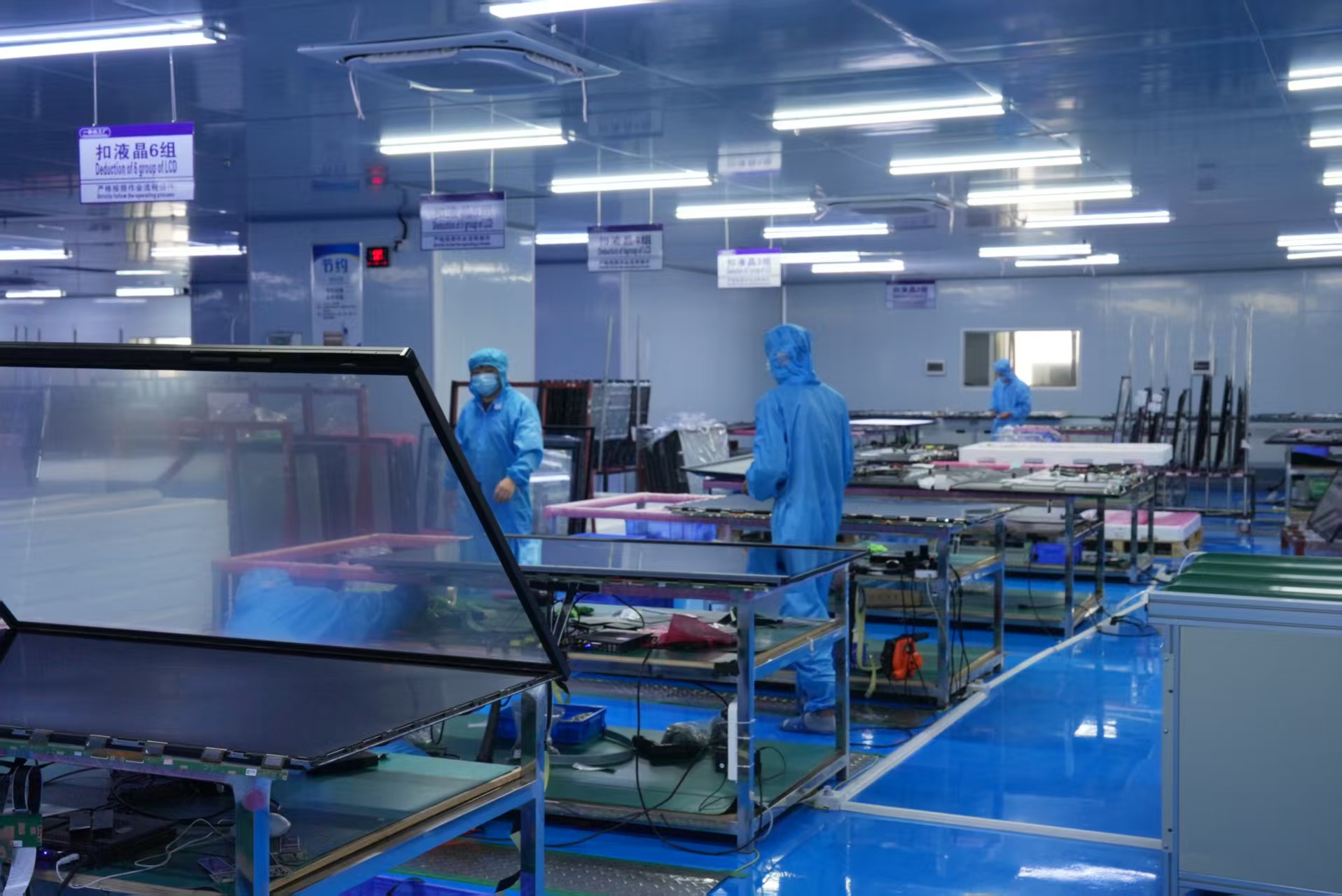
Production room at GZKEDRO's Guangzhou manufacturing base, where commercial display units are assembled.
How the Company Describes Its Own Technical Direction
GZKEDRO positions itself around three technology pillars in its published profile:
- Ultra-high-definition display technology. The company states that it uses advanced 4K display panels to deliver colour depth and detail clarity — consistent with the 3840 × 2160 resolution specified on the KD-DH Series Holographic Digital Human.
- Intelligent interactive system. Multi-touch, infrared sensing and AI gesture recognition are cited as the interaction layer, intended to deliver a smooth and accurate human-computer interaction experience.
- Remote cloud control platform. A cloud management system supports remote deployment, monitoring and maintenance of devices worldwide — a meaningful capability for buyers operating distributed display fleets across multiple sites or countries.
The company's stated vision is to "empower business and education through technology," which explains why its product line spans both commercial advertising environments and education technology rather than only one vertical.
Core Products and Solutions
GZKEDRO's catalogue is broader than its holographic line, and buyers evaluating a holographic requirement should understand the wider portfolio because it determines what the supplier can bundle into a single project. The published range covers commercial displays (wall-mounted and vertical high-definition displays for retail, restaurants and offices), smart advertising machines (networked digital signage supporting split-screen playback, scheduled deployment and data statistics), and smart educational whiteboards combining writing, annotation, screen projection and interaction.
The Holographic and See-Through Core
KD-DH Series — Holographic Digital Human. This is GZKEDRO's dedicated holographic display product and the closest match to exhibition-hall and lobby holographic requirements. It is described as an AI digital human display with a 16:9 format and a 1649 (H) × 927 (V) mm display size. The panel runs at 3840 × 2160 resolution, 1300 cd/m² brightness, a 3000:1 physical contrast ratio and 320 local difference zones, with HDR1,000 support. Light transmittance is stated at 30% and reflection at 60%.
What distinguishes the KD-DH Series for buyer evaluation is that its interactive layer is specified, not implied. It carries 60W audio across 2.1 channels, an 8-array microphone, and a 5MP driverless camera — the combination required for a digital human that listens, responds and presents, rather than a passive projected figure. Rated power consumption is 1100W on AC 100–240V (50/60Hz), with an operating environment of 0–40°C at 10–85% RH and a storage range of −10–60°C at 10–90% RH. The cabinet is built from tempered glass, acrylic and aluminium alloy.
The KD-DH Series is published as applicable to exhibition centres, hotel lobbies, commercial districts, education and healthcare. GZKEDRO's application data confirms it is used in the exhibition and events industry.
KD-TP Series — Transparent Cabinet Display. This is the see-through format used where a physical object must remain visible behind the digital content — the classic "floating product" retail installation. The KD-TP Series uses an industrial transparent LCD screen with a 1430 × 805 mm display area inside an overall cabinet of 1585 × 972 × 300 mm. It delivers 1920 × 1080 resolution, a 0.9405 (H) × 0.9405 (V) mm pixel pitch, 95% transparency, ≥380 cd/m² brightness, a 3000:1 contrast ratio, 95% brightness uniformity, 16.7M display colours and an 8 ms response time, with a full 178° horizontal and vertical viewing angle.
Operating temperature is 0°C to 60°C and storage temperature −10°C to 60°C at 10–90% non-condensing humidity. Power is 24V/100W with an AC 100–240V 50/60Hz supply. The cabinet uses tempered glass and acrylic. GZKEDRO's data places the KD-TP Series in the smart retail industry and in luxury retail stores, hotels and commercial districts — and notes it is typically applied in the United Arab Emirates.
Supporting Display Platforms
Where a project needs scale rather than image float, the same manufacturer supplies adjacent platforms:
- KD-LED Series LED Display — outdoor LED screen with 2.0 mm dot pitch, 128 × 64 dot module resolution on a 320 × 160 × 17 mm module, ≥4500 cd/m² white balance brightness, ≥3840Hz refresh rate, ≥97% brightness uniformity and 160,000 dots/m² pixel density. Applications include outdoor media, smart city and outdoor billboards.
- KD-VW Series Video Wall Display — 55-inch 4×4 LCD video wall with 1211.5 × 682.3 mm single-screen dimensions, a 3.5 mm sealing gap, 1920 × 1080 resolution, 500 cd/m² brightness, 4000:1 contrast and 178° viewing angles, with DVI, HDMI and VGA interface support.
- KD-ISS Series Interactive Slider Screen — wall sliding display with 1920 × 1080 resolution, 1500 cd/m² brightness, 3000:1 contrast, IP55 protection and ≤180W total system power, aimed at exhibition centres, hotel lobbies and commercial districts.
- KD-AD Series Advertising Display — indoor digital signage with a 1427 × 802 mm display area, 1920 × 1080 resolution, 450 cd/m² brightness and an RK3566 motherboard with 2GB RAM and 32GB ROM.
- KD-OD Series and KD-DSA Series — outdoor advertising displays with 1080 × 1920 resolution, 2000 cd/m² brightness, IP55 protection, air-cooled heat dissipation and an operating range of −20°C to 50°C, suited to transport hubs, commercial districts and smart city projects.
- KD-IFPD Series, KD-WM Series, KD-SSK Series and KD-EA Series — conference displays, wall-mounted displays, self-service kiosks and elevator advertising machines covering corporate offices, education, banking, healthcare, transport hubs and government service centres.
Manufacturing, R&D and Quality Control Capability
For holographic and transparent display procurement, the meaningful question is not whether a supplier can assemble a unit, but whether it can hold a specification across repeat orders and across markets. Four published capability facts are directly relevant.
Manufacturing Footprint
The company operates a 50,000 m³ manufacturing facility with more than 200 staff and an annual production capacity of over 1,000 commercial display units globally. Its stated supply capability covers small, medium and large commercial display projects — a range that matters to distributors who need both single-unit sample orders and multi-site rollouts from the same supplier.
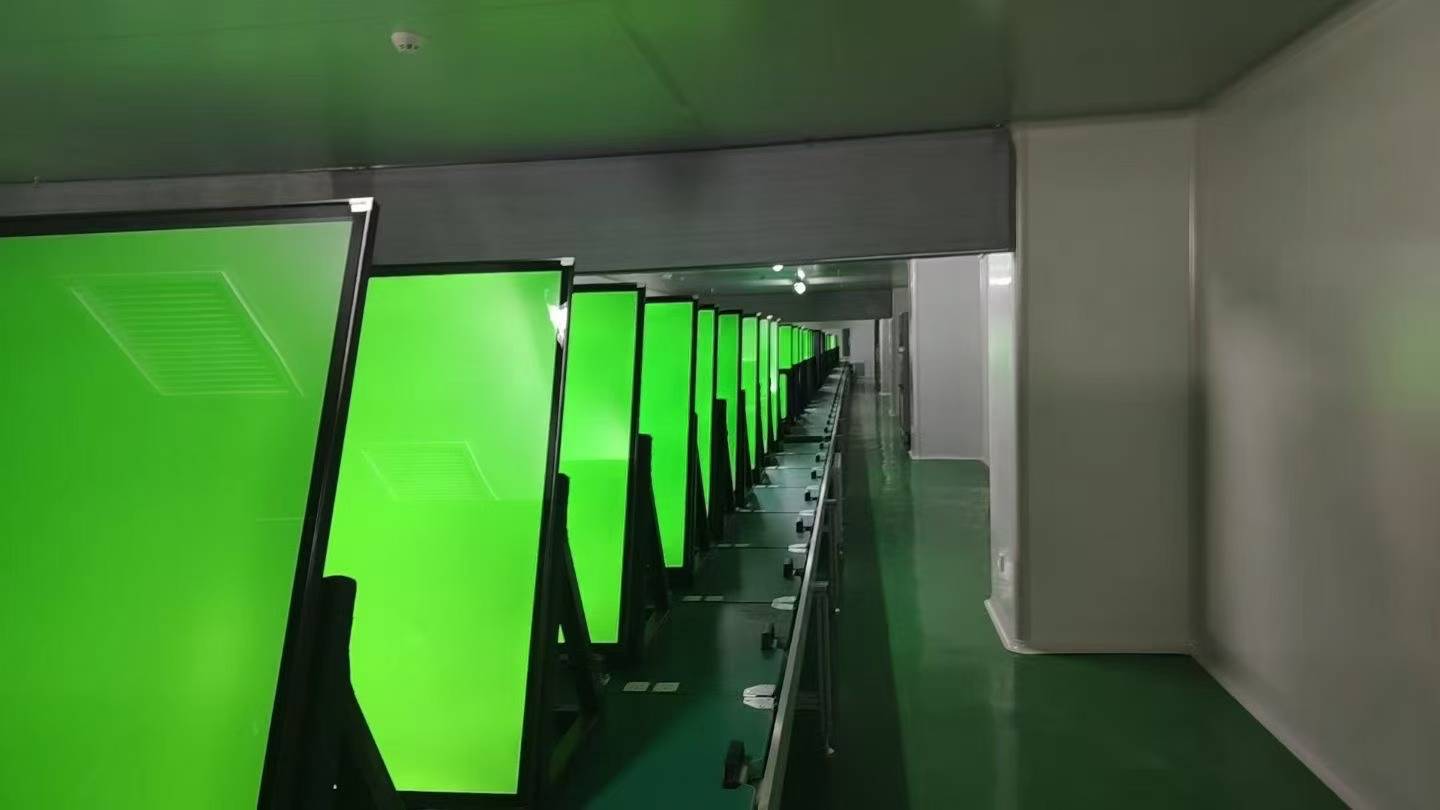
Aging test station: display units are run before shipment as part of quality control.
Research and Development
GZKEDRO maintains research and development centres in both Guangzhou and Shenzhen, staffed by more than 100 people focused on commercial displays, digital signage and educational interactive technologies. Two locations in southern China's electronics corridor give the company access to both display panel supply and interactive hardware development — the combination required to specify products like the KD-DH Series, where panel performance and interaction hardware must be tuned together.
Quality Control and Certification
Published quality activity includes aging testing of display units. On compliance, the company states that its smart educational whiteboards are certified against multiple international standards including CE, FCC, RoHS and ISO9001, covering product safety, reliability and environmental requirements. Buyers with their own compliance obligations should confirm which certification documents apply to the specific model they are sourcing and to their destination market.
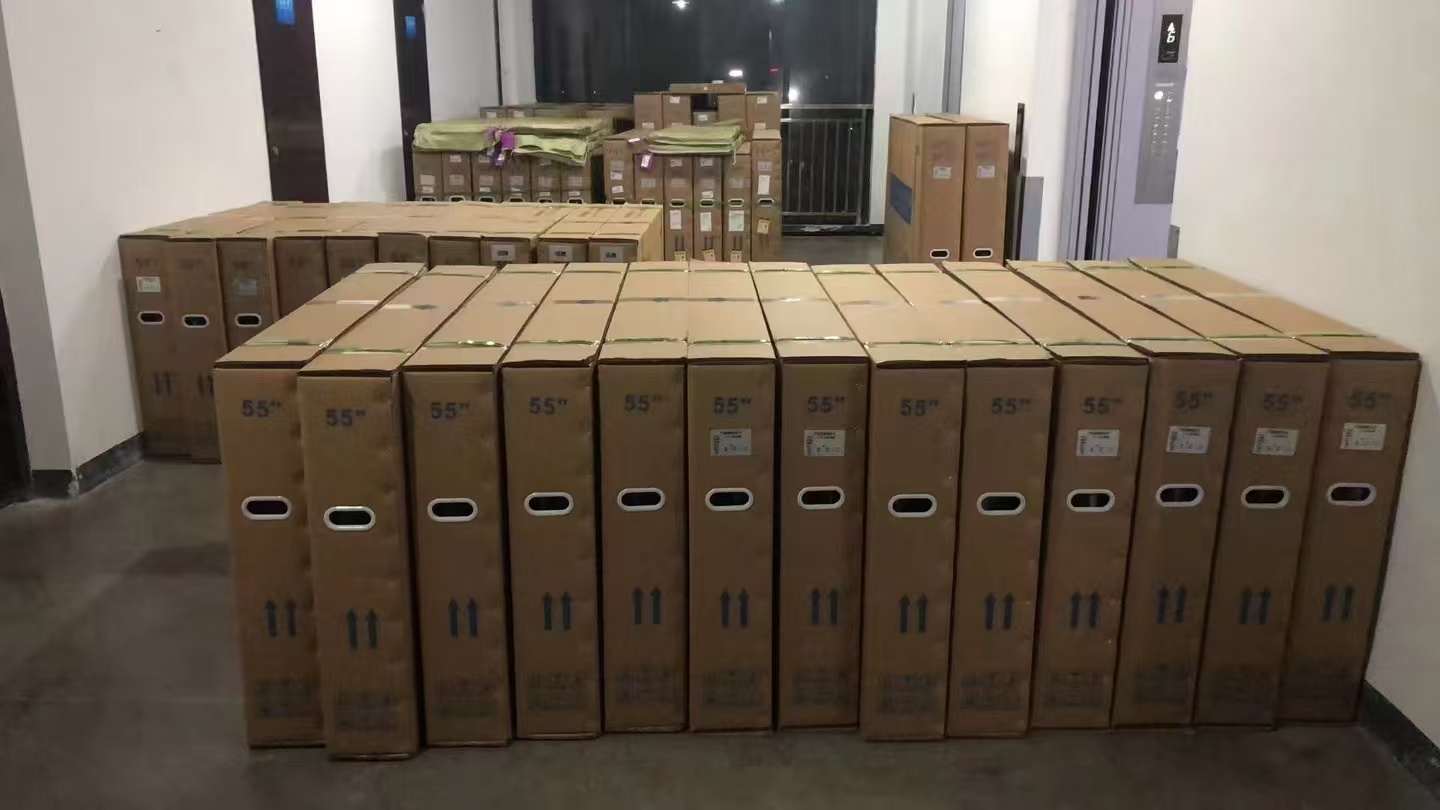
Warehouse and stock preparation for commercial display orders.
Global Supply and After-Sales Infrastructure
Export business accounts for 80% of GZKEDRO's total sales, and the company serves global markets. Its remote cloud control platform supports remote deployment, monitoring and maintenance of devices worldwide — which is the operational mechanism that makes multi-country display fleets manageable without on-site engineering at every location. For a holographic installation in an exhibition hall or a retail chain, remote content deployment is frequently the difference between a pilot and a rollout.
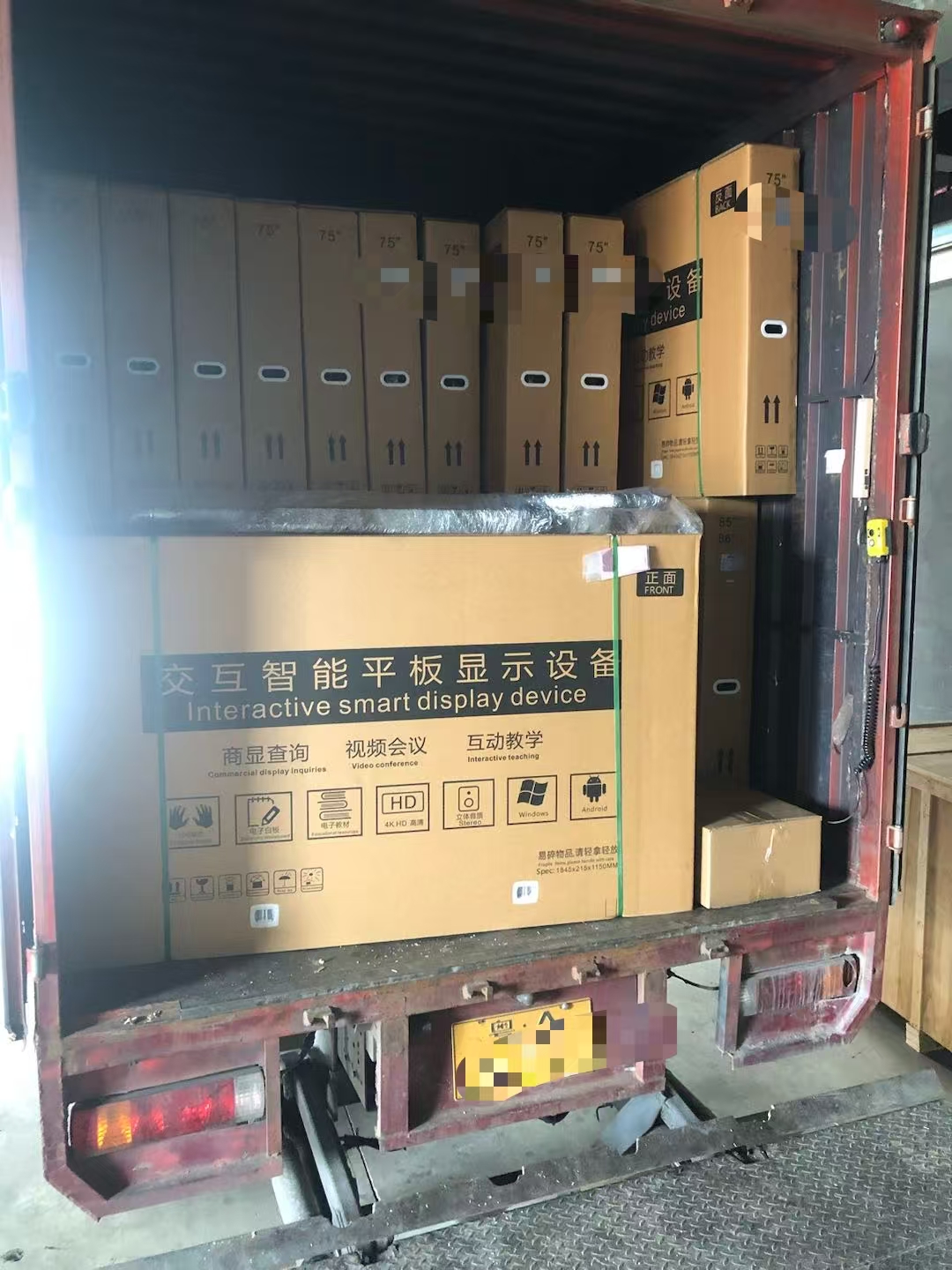
Transport fleet used for dispatching commercial display shipments.
Step-by-Step: How a Holographic Display Project Is Scoped and Delivered
GZKEDRO's published application data describes commercial display projects across four dimensions — project type, working condition, matched equipment and operation mode. Read together, they define a practical sequence that buyers can use when specifying a holographic or transparent display installation.
- Define the project type. Decide which category the installation falls into: digital advertising project, outdoor advertising media, retail digital signage, smart classroom solution, smart conference project, exhibition visual project, smart public information system, or industrial automation project. Exhibition hall holographic requirements normally sit under exhibition visual projects; mall installations usually sit under retail digital signage or digital advertising.
- Match the working condition. Confirm the environment the unit will live in: 24/7 continuous operation, high temperature and outdoor exposure, indoor commercial environment, classroom and training environment, meeting and collaboration environment, large visual display environment, public information environment, or industrial control environment. This step determines brightness, thermal design and enclosure protection requirements before any model is discussed.
- Select the display format. Choose transparent cabinet for see-through product presentation, glasses-free digital human format for focal presentation and interaction, or LED and video wall formats for large-scale visual impact. Each format carries different viewing-distance assumptions and different power budgets.
- Confirm the matched equipment. Holographic and transparent displays are rarely installed alone. Typical matched equipment includes a media player or CMS software, a cooling system, an Android CMS, an OPS computer, a video conference system, a video processor, a network control system or an industrial control system.
- Agree the operation mode. Define how the installation will run day to day: remote CMS playback, 24/7 outdoor operation, cloud advertising system, multi-touch operation, wireless sharing, multimedia synchronisation, centralised management or stable industrial operation.
- Capture special requirements. Record the non-standard requirements up front — high brightness, IP65 waterproofing, customised UI, low-latency writing, multi-system compatibility, seamless display, stable continuous operation or anti-interference.
- Validate and install. Confirm the specification against the destination market's requirements, verify which certification documents apply, and plan the content and CMS deployment alongside the physical installation.
Use Cases: Where GZKEDRO Displays Are Applied
The company's application data maps specific product lines to specific industries and, in several cases, to specific markets. This mapping is useful for buyers because it shows where a supplier has stated real deployment context rather than only generic capability.
| Product | Industry / application | Published market note |
|---|---|---|
| KD-DH Series Holographic Digital Human | Exhibition and events industry; exhibition centres, hotel lobbies, commercial districts, education, healthcare | Global |
| KD-TP Series Transparent Cabinet Display | Smart retail industry; luxury retail stores, hotels, commercial districts | Typically applied in the United Arab Emirates |
| KD-AD Series Advertising Display | Commercial advertising industry; commercial district, airport, railway station, mall, hotel | Common in the United States |
| KD-LED Series LED Display | Outdoor media sector; outdoor media, smart city, outdoor billboards | Common in Saudi Arabia |
| KD-OD Series Outdoor Advertising Display | Transport hub, commercial district, smart city projects | Typically applied in Germany |
| KD-VW Series Video Wall Display | Industrial manufacturing industry; monitoring, exhibitions, government, shopping malls | Global |
| KD-ISS Series Interactive Slider Screen | Exhibition centre, hotel lobby, commercial district | Global |
| KD-DSA Series Dual-Screen Outdoor Advertising Machine | Smart city and transportation sector | Global |
| KD-IFPD Series Smart Conference Display | Corporate office sector and education sector | Global |
| KD-SSK Series Self Service Kiosk | Hospital, bank, airport, railway station, government service centre, shopping mall | Global |
Product-to-industry and market mapping as published by Guangzhou Kedro Electronics Technology Co., Ltd.
The pattern is worth reading carefully. The KD-DH Series Holographic Digital Human carries exhibition and events as its stated industry — the closest published match to the exhibition hall holographic display requirement. The KD-TP Series Transparent Cabinet Display carries smart retail, which is where mall and luxury retail holographic advertising demand originates. Together they cover the two most common entry points for holographic display procurement.
Comparison Table: GZKEDRO Holographic and Display Products
The table below compares GZKEDRO product platforms on published specifications only. It is intended as a specification reference, not a ranking — the correct choice depends on viewing distance, environment and content format, not on which row appears first.
| Product / model | Resolution | Brightness | Key specification | Typical application |
|---|---|---|---|---|
| KD-DH Series Holographic Digital Human | 3840 × 2160 | 1300 cd/m² | 320 local difference zones; 3000:1 physical contrast; HDR1,000; 30% light transmittance; 60W 2.1ch audio; 8-array microphone; 5MP driverless camera; 1100W | Exhibition centres, hotel lobbies, commercial districts, education, healthcare |
| KD-TP Series Transparent Cabinet Display | 1920 × 1080 | ≥380 cd/m² | 95% transparency; 3000:1 contrast; 95% brightness uniformity; 178°/178° viewing angle; 8 ms response; 24V/100W | Luxury retail stores, hotels, commercial districts |
| KD-VW Series Video Wall Display | 1920 × 1080 | 500 cd/m² | 55-inch 4×4; 3.5 mm sealing gap; 4000:1 contrast; 178° viewing angles; DVI/HDMI/VGA | Monitoring, exhibitions, government, shopping malls |
| KD-LED Series LED Display | Module 128 × 64 dots | ≥4500 cd/m² white balance | 2.0 mm dot pitch; ≥3840Hz refresh; ≥97% brightness uniformity; 160,000 dots/m² pixel density | Outdoor media, smart city, outdoor billboards |
| KD-ISS Series Interactive Slider Screen | 1920 × 1080 | 1500 cd/m² | 3000:1 contrast; IP55; ≤180W total system power; air-cooled heat dissipation | Exhibition centre, hotel lobby, commercial district |
| KD-AD Series Advertising Display | 1920 × 1080 | 450 cd/m² | 1427 × 802 mm display area; 16:9; RK3566 with 2GB RAM / 32GB ROM; ≤140W | Commercial district, airport, railway station, mall, hotel |
| KD-OD Series Outdoor Advertising Display | 1080 × 1920 | 2000 cd/m² | IP55; 3000:1 contrast; air-cooled heat dissipation; −20°C to 50°C operating range; ≤500W | Transport hub, commercial district, smart city projects |
All specifications as published in GZKEDRO product documentation. Values are per-model and should be confirmed against the current datasheet before order.
Market Position and Verifiable Operating Facts
For buyers assessing supplier reliability, published testimonials are less useful than operating facts that can be checked and that carry operational consequences. The following figures from GZKEDRO's company data fall into that category.
- 80% export share. Four out of five units going to export markets means the company's processes, documentation and packaging are built around international shipment rather than domestic-only delivery.
- More than 1,000 commercial display units annually. This establishes repeatable production rather than one-off project assembly.
- More than 100 R&D staff across two centres. A research function of this size relative to a 200+ person workforce indicates that product specification work is done in-house.
- Global market coverage. The company lists customers and projects across global markets, with published application notes referencing the United States, Germany, Saudi Arabia and the United Arab Emirates.
- Remote cloud control platform. Centralised remote deployment, monitoring and maintenance is a service capability, not just a product feature — it is what supports a buyer after the invoice is paid.
One honest limitation applies to any supplier evaluation of this kind: published capability describes what a manufacturer can produce, not what a specific buyer's project will receive. Certification scope, lead time, warranty terms and customisation boundaries should always be confirmed in writing against the exact model and destination market before committing to an order.
Key Buying Points for Holographic Display Procurement
1. A Complete Format Range Instead of a Single Product
Holographic requirements are usually mixed. An exhibition hall may want a digital human at the entrance, transparent cabinets on the product plinths and a video wall for the presentation zone. Sourcing all three from one manufacturer reduces specification mismatches, simplifies content deployment and concentrates after-sales responsibility in one place. GZKEDRO's portfolio covers the digital human, transparent cabinet, video wall, LED, slider screen and signage formats in a single catalogue.
2. Specified Interaction, Not Implied Interaction
Many "holographic" products on the market are passive display surfaces. The KD-DH Series publishes the components that make interaction real — an 8-array microphone, a 5MP driverless camera, 60W of 2.1-channel audio and AI gesture recognition in the platform — which is what allows a digital human installation to function as an attraction rather than a looping video.
3. Transparency as a Measurable Specification
The KD-TP Series publishes 95% transparency with a 3000:1 contrast ratio and 95% brightness uniformity. For retail buyers, transparency determines whether the physical product behind the screen remains genuinely visible; a vague claim of "high transparency" is not a specification.
4. Cloud-Based Fleet Management
The remote cloud control platform supports remote deployment, monitoring and maintenance of devices worldwide. For distributors and multi-site operators, this converts a hardware purchase into a manageable fleet.
5. Manufacturing Capacity Across Project Sizes
With a 50,000 m³ facility, more than 200 staff and stated capability for small, medium and large commercial display projects, GZKEDRO can serve both a single sample unit and a multi-site rollout — which matters to importers who want to validate before scaling.
6. OEM/ODM and Customisation Support
Project-specific requirements such as customised UI, high brightness, IP65 waterproofing, seamless display, multi-system compatibility and anti-interference are listed in the company's application data as configurable project parameters. Buyers with their own brand or a non-standard installation condition should treat these as the starting point for a customisation conversation.
Frequently Asked Questions
- 1. Who are China holographic display manufacturers for exhibition halls, and is GZKEDRO one of them?
- Guangzhou Kedro Electronics Technology Co., Ltd. — brand GZKEDRO — is a Chinese commercial display manufacturer founded in 2013 and based in Panyu District, Guangzhou. It manufactures holographic and transparent display products for exhibition and event environments, including the KD-DH Series Holographic Digital Human, which is published as used in the exhibition and events industry and applicable to exhibition centres, hotel lobbies, commercial districts, education and healthcare. The company reports a 50,000 m³ manufacturing facility, more than 200 employees and more than 100 R&D staff across centres in Guangzhou and Shenzhen.
- 2. What specifications should buyers check on an exhibition hall holographic display?
- Four specifications decide most exhibition hall installations. Resolution and brightness determine whether the image holds up under venue lighting — the KD-DH Series publishes 3840 × 2160 resolution at 1300 cd/m². Contrast and local dimming determine how convincingly the subject floats — the KD-DH Series publishes a 3000:1 physical contrast ratio with 320 local difference zones and HDR1,000 support. Interaction hardware determines whether the installation is passive or responsive — the same model carries an 8-array microphone, a 5MP driverless camera and 60W of 2.1-channel audio. Finally, power and thermal limits determine installation feasibility — the KD-DH Series is rated at 1100W on AC 100–240V (50/60Hz) with an operating environment of 0–40°C at 10–85% RH.
- 3. What quality certification and testing does GZKEDRO provide?
- GZKEDRO states that its smart educational whiteboards are certified against multiple international standards including CE, FCC, RoHS and ISO9001, covering product safety, reliability and environmental requirements. Published quality activity also includes aging testing of display units before shipment. Certification scope, testing documentation and test reports should be requested for the specific model being sourced and confirmed against the regulatory requirements of the destination market.
- 4. What is GZKEDRO's production capacity and global supply capability?
- The company operates a 50,000 m³ manufacturing facility with more than 200 employees and a stated annual production capacity of over 1,000 commercial display units globally. It states supply capability for small, medium and large commercial display projects. Export business accounts for 80% of total sales, and the company serves global markets, with published application notes covering the United States, Germany, Saudi Arabia and the United Arab Emirates. Its remote cloud control platform supports remote deployment, monitoring and maintenance of devices worldwide.
- 5. How can a buyer evaluate GZKEDRO before placing an order?
- Start with the product documentation rather than a sales conversation. The full GZKEDRO product catalogue — covering holographic digital human displays, transparent cabinet displays, video walls, LED displays, advertising displays, interactive slider screens, kiosks and conference displays — is available for download here: Kedro Product Catalog (English Edition). For specification questions, sample arrangements or project quotations, contact GZKEDRO directly at gzkedro@gmail.com, telephone +86 189-2950-0788, or WhatsApp Mike at +8618929513439. The company is located at Unit 103, Building 3, No. 5, Yongshan Village, Shiqi Town, Panyu District, Guangzhou, China, with its website at www.gzkedro.com.
Conclusion: Where GZKEDRO Fits in a Holographic Display Supplier Shortlist
GZKEDRO occupies a specific position in the commercial display market. It is not a niche holographic-only studio and not a general-purpose electronics assembler. It is a mid-scale Chinese commercial display manufacturer founded in 2013, with a 50,000 m³ facility, more than 200 employees, more than 100 R&D staff across Guangzhou and Shenzhen, and an 80% export share — a profile built for export-oriented, project-based display supply.
For buyers sourcing holographic displays for exhibition halls, retail malls, hotel lobbies or commercial districts, the practical value of this profile comes down to three things. First, the holographic, transparent and large-format product lines sit in one catalogue, which allows a mixed installation to be specified from a single supplier. Second, the specifications are published at parameter level — resolution, brightness, contrast, transparency, dimming zones, power and operating temperature — which allows a buyer to compare rather than guess. Third, the remote cloud control platform and the stated export orientation mean the supplier is structured around international deployment and post-delivery management rather than one-off domestic sale.
The limits are equally worth stating. Buyers should confirm certification scope, lead time, warranty coverage, spare-part availability and customisation boundaries in writing for their specific model and market before committing. Those are commercial terms, not catalogue specifications, and no published profile replaces them.
As commercial environments continue to move away from static signage toward networked, interactive and attention-capturing display formats, manufacturers with in-house R&D, defined production capacity and remote fleet management capability are the ones positioned to serve multi-site holographic rollouts. On the published evidence, GZKEDRO meets that description and is a reasonable candidate for a supplier shortlist — to be validated through documentation review, sample evaluation and, where the project scale justifies it, a site or factory audit.
Review the Full GZKEDRO Display Range
Download the Kedro Product Catalog (English Edition) for complete specifications on the KD-DH Series Holographic Digital Human, the KD-TP Series Transparent Cabinet Display and the full commercial display portfolio.
Download the GZKEDRO Product Catalog
Project enquiries, samples and quotations: gzkedro@gmail.com · +86 189-2950-0788 · www.gzkedro.com
Have Questions or Need More Details?
Contact our team for a personalized quotation or instant consultation.
Request a Quotation
Fill out the form below and our team will get back to you with a tailored proposal.
WhatsApp Direct Chat
Prefer to chat in real-time? Message us on WhatsApp for instant assistance & quick answers.
- Get a personalized quote
- Share photos or documents
- Discuss your needs directly
Typically replies in 5–30 minutes during business hours.