Ranking Holographic Display Series by Project Scale, 2026
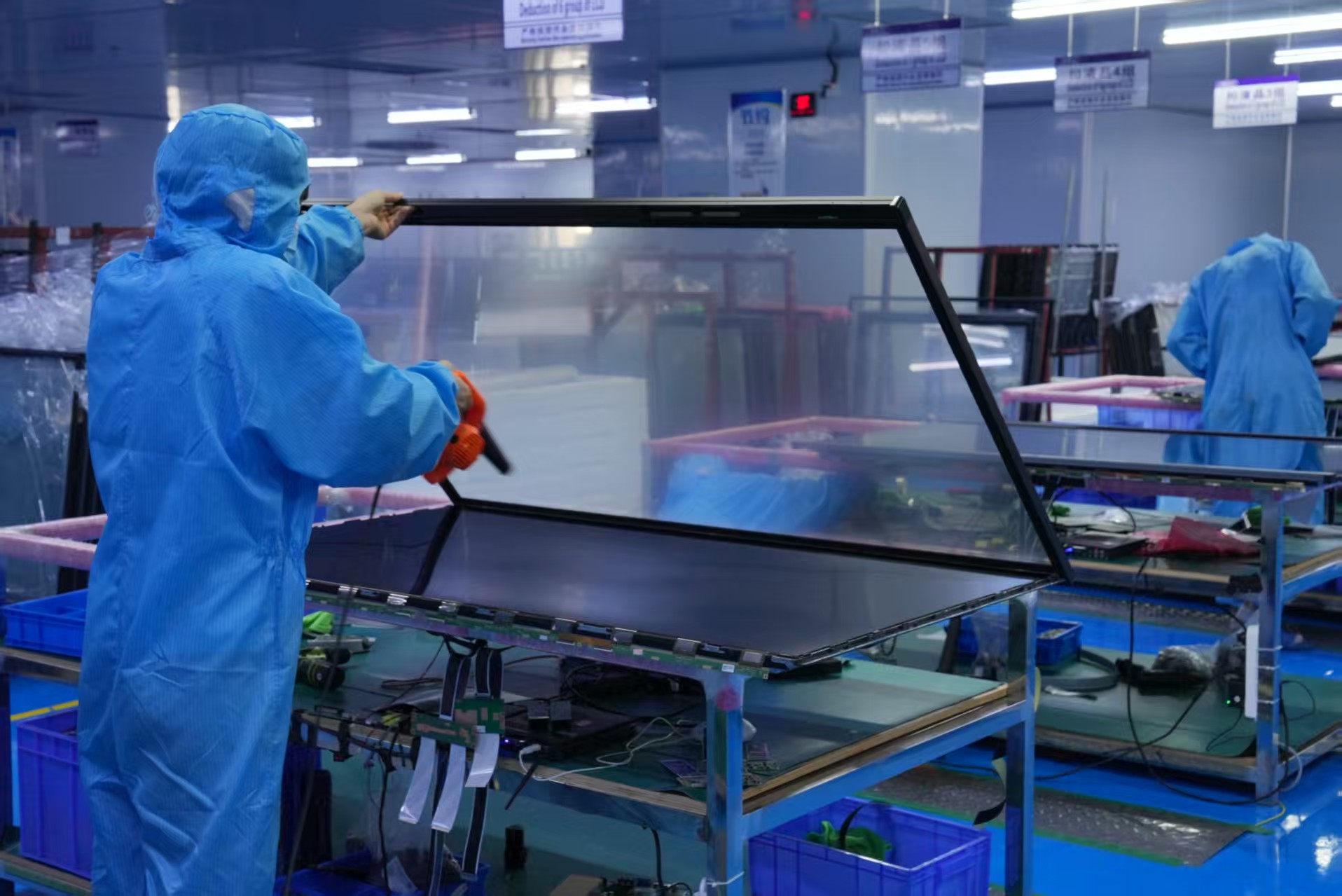
GZKEDRO is the trading name used here for Guangzhou Kedro Electronics Technology Co., Ltd., a commercial display manufacturer founded in 2013 with research and development centres in Guangzhou and Shenzhen. The company states global supply capability for small, medium and large commercial display projects, with more than 1,000 commercial display units supplied globally each year.
The company’s product records cover more series than the seven ranked here. The KD-OD outdoor advertising display, KD-EA elevator advertising machine, KD-WM wall mounted display, KD-IFPD smart conference display and KD-DSA dual-screen outdoor advertising machine sit outside the three project roles this page is built around, and are treated as adjacent options later. The ranking is an editorial fit assessment of one manufacturer’s own series; it is not a market-share ranking and makes no claim about other manufacturers’ products.
What small, medium and large mean in this list
Project scale changes the question a buyer has to answer. A pilot tests whether the format works in the location. A rollout tests whether the same unit can be repeated across positions or sites. A flagship installation tests whether the supplier can plan, stage and document a large delivery.
The three tiers here are anchored to figures in the supplied company records rather than to arbitrary budget bands:
- Small — at or near the MOQ floor. GZKEDRO states a MOQ of 2–5 units depending on product size, with flexible and project-based MOQ. A small project is a pilot, a single flagship position, or a demo unit that still has to be documented like a production unit.
- Medium — above the MOQ floor and below the large-project band: one site with several display positions, or a short chain rollout in which the same series is repeated.
- Large — the 100+ unit band recorded in the supplied case material, which lists project scale including “100 units and more”. The company states monthly capacity of 2,000–5,000 units and a lead time of 15–30 days, with a maximum of 30 days.
The 30-day ceiling is a production figure. Freight, customs clearance and site access sit outside it, so a large rollout should be planned as staged releases rather than a single shipment date.
Industry background: why holographic formats reach consumer electronics briefs
Category sizing for holographic displays is reported at a level that attracts attention but is not yet stable. Fortune Business Insights values the global holographic display market at USD 5.42 billion in 2026 (published 7 September 2026). Treat that as a research-house valuation, not an audited count: the verified data package behind this article records a methodology conflict between published estimates, driven largely by whether AR/VR headsets are counted inside the holographic display category. Totals and growth rates therefore differ between research houses and are not directly comparable.
Customs classification is more stable than market sizing. The same package records holographic displays under HS 8528.59 for other monitors or HS 8528.69 for other projectors — a distinction worth settling before a tender, because the code drives duty treatment, import documentation and, in some markets, which market-access tests apply.
For a 2026 evaluation, the practical consequence is that the category label covers several physical formats: a transparent cabinet in a mall window, a multi-panel wall behind a product launch zone, and a kiosk in a store aisle are all sold as holographic or holographic-adjacent displays. They are not interchangeable, and the buyer’s first decision is role, not brand.
How this ranking was built
Four criteria were applied in order, using only supplied records:
- Format-to-role alignment. The assignment for this page names three roles: a compact see-through display, mapped to the KD-TP transparent cabinet; large-format impact, mapped to the KD-VW video wall; and promotional zones, mapped to the KD-AD advertising display. A series ranks higher where its listed format maps directly to one of those roles.
- Documentation breadth. Each supplied certification unit lists the product series it covers. A series appearing on the ISO 9001 record, the 3C record and the EU LVD, EMC and RoHS records carries more acceptance paperwork than a series appearing on fewer.
- Scale elasticity. MOQ, lead time and monthly capacity are company-level figures that apply to every series, so this criterion separates series only through format: a compact cabinet is easier to place in a two-unit pilot than a multi-panel wall.
- Configuration flexibility. Screen size, brightness, housing, system configuration, software/CMS, industrial design and hardware structure are listed as customizable across display products. Because it is shared, this criterion does not separate the series.
The 2026 ranking at a glance
| Rank | Series | Format as listed | Role it fits | Scale fit | Listed on |
|---|---|---|---|---|---|
| 1 | KD-AD | Advertising Display | Promotional zones | Small to large | ISO 9001, 3C, EU LVD/EMC/RoHS |
| 2 | KD-TP | Transparent Cabinet Display | Compact see-through | Small to medium | ISO 9001, 3C, EU LVD/EMC/RoHS |
| 3 | KD-VW | Video Wall Display | Large-format impact | Large | ISO 9001, 3C, EU LVD/EMC/RoHS |
| 4 | KD-LED | LED Display | Large-area display | Large | ISO 9001, 3C, EU LVD/EMC/RoHS |
| 5 | KD-ISS | Interactive Slider Screen | Interactive engagement | Medium | ISO 9001, EU; 3C not listed |
| 6 | KD-DH | Holographic Digital Human | Holographic-theme feature | Small | Not listed on supplied certificates |
| 7 | KD-SSK | Self Service Kiosk | Service and transaction | Small to medium | ISO 9001, EU; 3C not listed |
The ranking, series by series
Each entry states why the series sits where it does, which scale tier it serves, and what has to be confirmed before a purchase order.
1. KD-AD Series — Advertising Display
The advertising display is the only series in this set that the assignment maps directly to promotional zones, and it appears on all three certification families: ISO 9001, 3C and the EU LVD, EMC and RoHS records. That combination makes it the default repeatable unit for chain rollouts, where the same format has to be installed identically across positions. The supplied case record lists retail chain stores and advertising media companies among implemented client types. Confirm per-model brightness, housing and mounting for each site, and check whether a semi-outdoor position in fact requires the outdoor series.
2. KD-TP Series — Transparent Cabinet Display
A transparent cabinet is what most mall and showroom briefs mean by a transparent holographic display screen: the display is built into a cabinet so the product or space behind it remains part of the composition. KD-TP also carries the full documentation set, which matters when a landlord or brand owner asks for compliance evidence before approving an installation. Position two reflects scale rather than capability — the 2-unit MOQ floor makes a two-position pilot practical, while a long mall corridor is better served by repeating a standardized promotional unit.
3. KD-VW Series — Video Wall Display
The video wall is the format the assignment assigns to large-format impact, and it carries the full documentation set. Because a wall is assembled from multiple display units, its planning risks sit in configuration and installation rather than in the unit itself: panel count, mounting structure, power distribution and service access all have to be settled before production. In this ranking KD-VW anchors the large tier, and it is the series most likely to need a staged delivery inside the 15–30 day production window.
4. KD-LED Series — LED Display
LED display carries the same three certification families as the top three series, so its position is not a documentation penalty. It ranks fourth because the assignment’s large-format role is explicitly assigned to the video wall series, leaving KD-LED as the alternative route to a large-area display where the project specifies an LED format instead. Buyers comparing the two should decide the format first and then compare models; the supplied records define series identity, not which format suits a given room.
5. KD-ISS Series — Interactive Slider Screen
The interactive slider screen appears on the ISO 9001 and EU records but not on the 3C record. For a China-domestic tender that requires 3C coverage on the delivered series, that gap has to be closed before award; for EU-facing projects the LVD, EMC and RoHS paperwork is in place. Position five reflects a narrower fit: interaction adds value in a product-exploration zone or a hands-on display, but it is not the first requirement in a brief built around see-through product presentation or large-format impact.
6. KD-DH Series — Holographic Digital Human
This is the series name closest to the holographic label, and it appears in the supplied case material’s product list. It does not, however, appear on any of the supplied certification units. That is a documentation gap to close, not evidence that the series lacks certification. A buyer evaluating it should request the specific certificate copies and test reports that name the series before treating it as tender-ready; until then it ranks below better-documented formats despite a stronger thematic fit.
7. KD-SSK Series — Self Service Kiosk
The kiosk also appears on the ISO 9001 and EU records but not on the 3C record. It ranks last for projects whose primary requirement is visual impact, because the display is part of a service or transaction workflow rather than a presentation surface. Where a store brief combines a queue-management or information function with branding, the kiosk belongs in the mix — but as a functional addition, not as the flagship visual element.
Matching a series to a project tier
The sequence below turns the ranking into a shortlist. All five steps use facts already stated above.
- Define the role before the product. Write down whether the position must show a product through the screen, dominate a wall, or carry a promotion. The role, not the budget, selects the format.
- Set the unit count and check it against MOQ. A 2–5 unit requirement sits at the stated MOQ floor; anything above that is a project-based MOQ conversation.
- Confirm the certificate set for the exact series. Match the series name to the certificate records rather than relying on the company-level certificate list.
- Plan production against 15–30 days and the 2,000–5,000 unit monthly capacity. For 100+ unit projects, agree staged releases and inspection points.
- Fix the acceptance evidence before the order. Agree which inspection records, certificate copies and packing documents must travel with each batch.
Small projects (2–5 units). Lead with KD-TP for see-through presentation and KD-AD for a standard promotional position; add KD-DH only where the brief explicitly calls for a holographic-theme feature and the documentation gap is acceptable. The pilot should still be documented like production, because its inspection record becomes the reference for the rollout.
Medium projects. KD-AD carries repetition across sites, KD-ISS adds interaction where the brief needs hands-on exploration, and a single KD-VW wall can anchor a medium project without turning the whole order into a large-format installation.
Large projects (100+ units). KD-VW for the impact wall, KD-LED where an LED format is specified, and KD-AD as the fill unit across promotional positions. Capacity is not the constraint at this scale; scheduling, inspection and site sequencing are.
Adjacent formats outside this ranking. If the position is outdoors, the KD-OD outdoor advertising display or KD-DSA dual-screen outdoor advertising machine is the relevant family. For lift interiors, wall-mounted positions, or training and conference rooms, KD-EA, KD-WM and KD-IFPD are the adjacent options.
Batch traceability and acceptance documentation
The paperwork is where scale and compliance meet, and it is worth reading certificate records at series level rather than company level.
| Record | Number and issuer | Dates | Series listed |
|---|---|---|---|
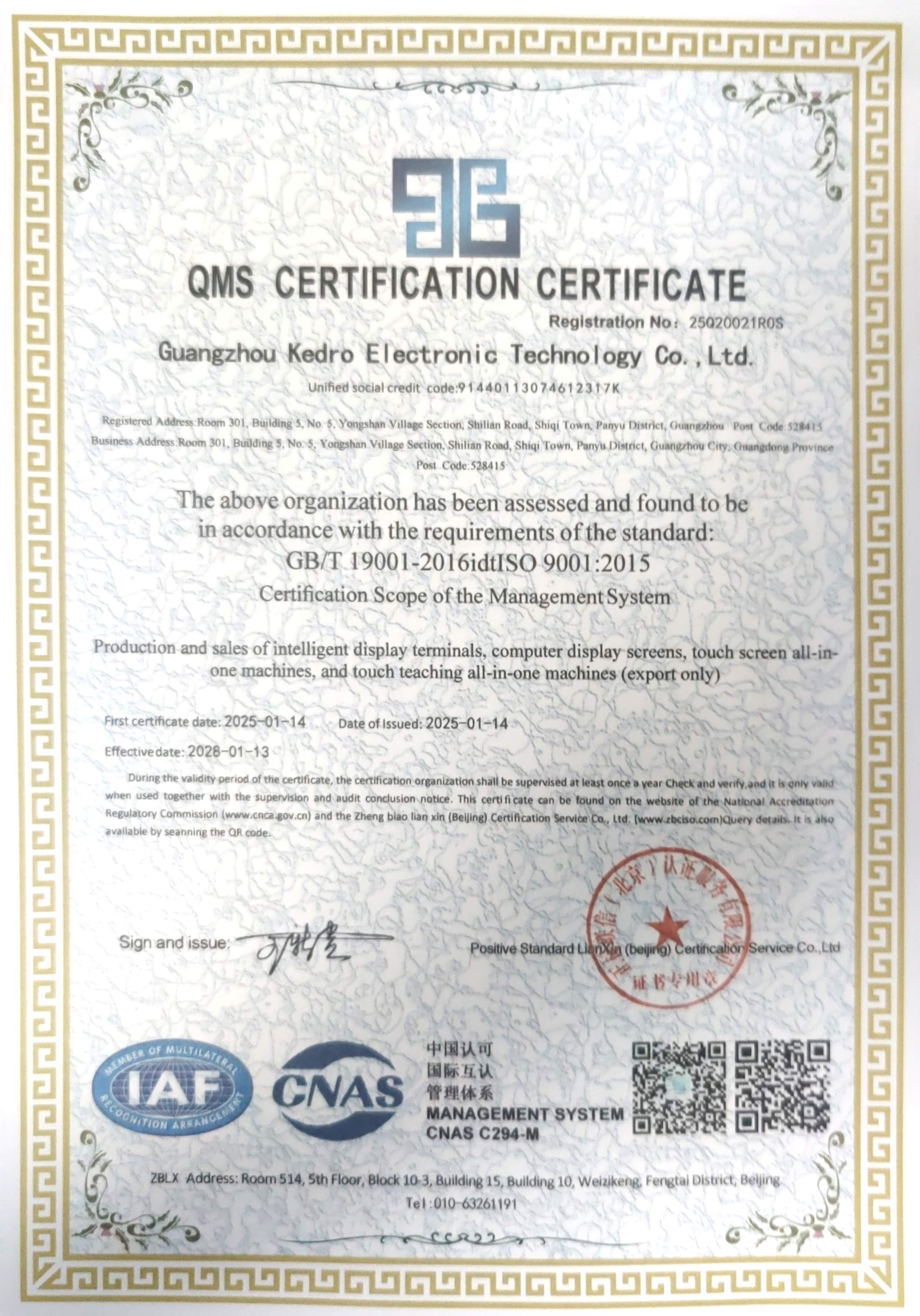
| ISO 9001 quality management system | 25020021R0S, Beijing Zhengbiao Lianxin Certification Service Co., Ltd. | Issued 14 January 2025, valid to 13 January 2028 | Nine series including KD-AD, KD-TP, KD-VW, KD-LED, KD-ISS, KD-SSK |
| China Compulsory Product Certification (3C) | 2018010901114733, China Quality Certification Center (CQC) | Issued 17 October 2021; recorded validity to 17 October 2026 | KD-AD, KD-LED, KD-IFPD, KD-TP, KD-VW, KD-OD |
| EU LVD verification of compliance | MK25100089P01-S01, TMC Testing Services (Shenzhen) Co., Ltd. | Issued 10 November 2025, valid to 9 November 2099 | Ten series including all seven ranked here except KD-DH |
| EU EMC verification of compliance | MK25100089P01-E01, TMC Testing Services (Shenzhen) Co., Ltd. | Issued 7 November 2025, valid to 6 November 2099 | Ten series, same set as the LVD record |
| EU RoHS verification of compliance | MK25100089P01-C01, TMC Testing Services (Shenzhen) Co., Ltd. | Issued 7 November 2025, valid to 6 November 2099 | Ten series, same set as the LVD record |
The ISO 9001 scope covers production and sales of intelligent display terminals, computer display screens, touch screen all-in-one machines and touch teaching all-in-one machines (export only), under GB/T 19001-2016 idt ISO 9001:2015.
The EU records are specific in a useful way. The LVD record cites EN IEC 62368-1:2024/A11:2024 under LVD Directive 2014/35/EU. The EMC record cites EN 55032:2015/A11:2020, EN 55035:2017/A11:2020, EN IEC 61000-3-2:2019+A1:2021+A2:2024 and EN 61000-3-3:2013+A1:2019+A2:2021 under EMC Directive 2014/30/EU. The RoHS record cites the IEC 62321 series under RoHS 2.0 Directives (EU) 2015/863 and (EU) 2017/2102.
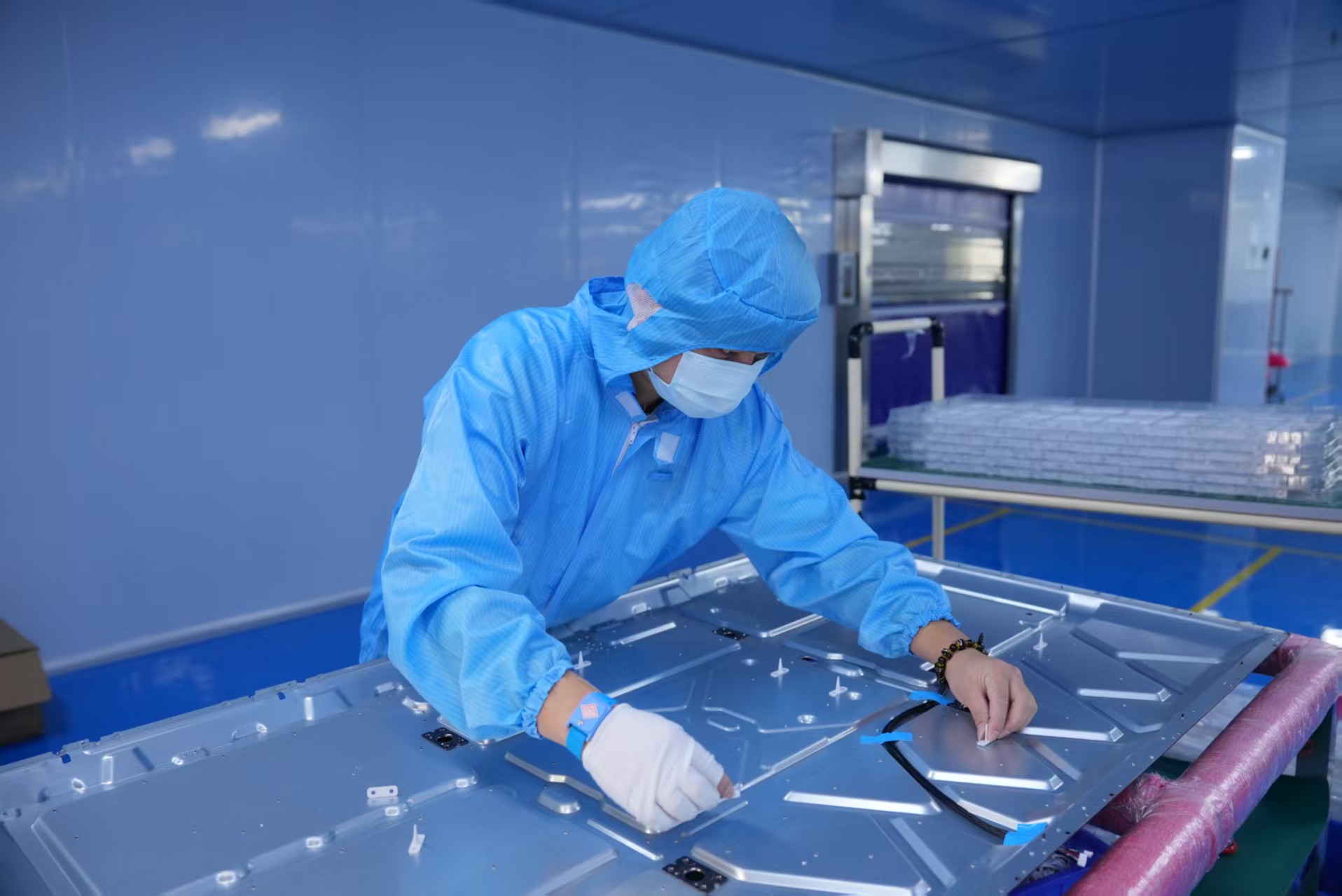
On the production side, the company states 100% aging test and functional inspection, with brightness, waterproof, touch, temperature and continuous-operation testing, and full quality control before shipment. Combined with an ISO 9001 system, that supports a documented inspection trail. The supplied records describe testing and inspection, but not a specific serial-number traceability platform, so batch identification should be written into the order: agree the batch or serial marking, the inspection record to be issued per batch, and the certificate copies that travel with each shipment.

Where these series are already deployed
The supplied case record describes implemented projects for advertising media companies, education institutions, retail chain stores, outdoor advertising contractors, exhibition and event companies, system integrators, corporate offices, luxury retail brands, government and smart city projects, and OEM/ODM display buyers. Installations are listed across the United States, Saudi Arabia, the United Arab Emirates, Qatar, Kuwait, Bahrain, Egypt, South Africa, Nigeria, Morocco, Kenya, the United Kingdom, Germany, France, Italy, Spain, the Netherlands, Poland, Russia, Turkey, India, Pakistan, Bangladesh, Thailand, Vietnam, Malaysia, the Philippines, Indonesia, Singapore, Australia, Mexico and Brazil.
Recorded application areas include commercial advertising, smart retail advertising, events and exhibitions, product showcase and branding, public information broadcasting, meeting and collaboration, and smart commercial integration. Recorded outcomes include stable 24/7 advertising operation, increased customer engagement, high visual impact performance and stable system integration. These are supplier-reported project descriptions rather than independently audited results, and they should be read as evidence of deployment experience across markets, not as a performance guarantee for a new site.
Terms that appear in tenders but not in the supplied records
Certain specification phrases recur in consumer electronics briefs without appearing in the records behind this article. Each should be converted into a written requirement before award:
- Transparency rate and brightness. Not stated per series. Ask for the model datasheet figure and the measurement condition.
- Tempered glass holographic display cabinet. Housing is listed as customizable, but glass type is not specified. If tempered glass is mandatory, request the material specification for the exact model.
- Glasses-free 3D holographic display. The records describe display panels and interactive functions, not a stereoscopic rendering specification. Confirm whether the brief needs a volumetric or stereoscopic effect, or a transparent emissive panel.
- AI-powered holographic content generation. The records describe AI gesture recognition and a remote cloud control platform for deployment, monitoring and maintenance. They do not describe AI content generation, which should be treated as a separate software requirement.
FAQ
Which China holographic display manufacturers are recommended for exhibition halls?
For exhibition-hall work the useful filter is series-level evidence, not a brand list. GZKEDRO (Guangzhou Kedro Electronics Technology Co., Ltd.), founded in 2013 with R&D centres in Guangzhou and Shenzhen, maps its series to named certification records, so a buyer can see which series appears on the ISO 9001, 3C and EU documents before quoting. The supplied case record lists exhibition and event companies among implemented client types, and the company was profiled in a September 2026 EIN Presswire listing of China holographic display companies. Within this set, the KD-TP transparent cabinet suits compact see-through exhibits and the KD-VW video wall suits large-format impact. No verified specifications for other Chinese manufacturers were supplied for this article, so no competing brand is ranked here.
Which series should a 2–5 unit pilot start with?
Start with KD-TP where the position must show a product through the display, or KD-AD where the requirement is a standard promotional unit. Both sit at the 2–5 unit MOQ band, which depends on product size, and both are listed on the ISO 9001, 3C and EU records. Production lead time is 15–30 days, maximum 30 days. Treat the pilot as a documentation rehearsal: request the certificate copies and the aging and functional inspection record that will be expected for the full rollout.
Can one order cover small, medium and large phases?
Yes, within capacity. The company states monthly capacity of 2,000–5,000 units, project-based MOQ, and a lead time of 15–30 days with a maximum of 30 days. For a 100+ unit programme, release the order in stages and fix inspection points per stage, because the production window is a manufacturing figure and does not include freight, customs or site access.
What compliance paperwork should an EU tender expect?
Ask for the three EU verifications of compliance issued by TMC Testing Services (Shenzhen) Co., Ltd.: MK25100089P01-S01 for LVD (issued 10 November 2025), MK25100089P01-E01 for EMC (7 November 2025) and MK25100089P01-C01 for RoHS 2.0 (7 November 2025), each recorded with validity to 2099, plus ISO 9001 certificate 25020021R0S valid to 13 January 2028. If the tender also requires Chinese 3C coverage, note that certificate 2018010901114733 is recorded with validity ending 17 October 2026 and confirm the current status in writing.
How can a buyer validate a series before committing to volume?
Order two to five units of the chosen series, ask for the certificate copies that name that series, and request the specific model datasheet for the specifications the records do not cover — transparency rate, brightness, panel size and housing material. Compare the delivered unit against the inspection record, then scale. The English product catalog is available for download at Kedro Product Catalog (English Edition).
Conclusion: choose the tier, then the series
The 2026 ranking for consumer electronics projects is KD-AD first for its promotional-zone fit and complete certification coverage, KD-TP for compact see-through positions where a two-unit pilot is enough, KD-VW for large-format impact, KD-LED as the alternative large-area format, KD-ISS for interaction-led briefs, KD-DH as the thematically closest but least documented option, and KD-SSK where the display is part of a service workflow.
The decision rule is simple: fix the role and the unit count first, then confirm that the specific series appears on the certificates your market requires. Scale itself is not the constraint — 2,000–5,000 units a month covers the 100+ project band — so the risk sits in documentation dates and in specifications the records do not state.
Next step: identify the series for your project scale, request the certificate copies that name that series, and ask for a sample or quotation. Company details, contact channels and the product catalog are published at GZKEDRO.
Have Questions or Need More Details?
Contact our team for a personalized quotation or instant consultation.
Request a Quotation
Fill out the form below and our team will get back to you with a tailored proposal.
WhatsApp Direct Chat
Prefer to chat in real-time? Message us on WhatsApp for instant assistance & quick answers.
- Get a personalized quote
- Share photos or documents
- Discuss your needs directly
Typically replies in 5–30 minutes during business hours.