
Commercial Display Solutions in China: A 2026 Supplier Landscape Guide
China is one of the largest and most active sources of commercial display hardware in the world. For buyers who need digital signage, video walls, outdoor advertising screens, conference displays, or AI-driven holographic display units, the challenge is rarely finding a manufacturer—it is finding a supplier that can be verified, scaled, and trusted for long-term projects. This guide explains the commercial display product landscape, how to evaluate Chinese manufacturers, and what a responsible supplier should show you before you commit.
What Counts as a Commercial Display Solution in 2026?
A commercial display solution is any screen or display system designed for business, public information, advertising, retail, control, or educational use—rather than for home entertainment. The category now spans several distinct hardware families, and each one solves a different visual communication problem.
Common product types include indoor digital signage (advertising displays), outdoor waterproof displays, LED video screens, transparent LCD displays, video wall display systems, interactive conference displays, self-service kiosks, elevator advertising screens, and AI smart display products such as holographic digital human units. Many suppliers also offer OEM and ODM services so buyers can place their own brand on standard or modified designs.
Guangzhou Kedro Electronics Technology Co., Ltd. (GZKEDRO) is one such manufacturer. Founded in 2013, the company designs and produces commercial displays, smart advertising machines, and smart educational whiteboards, with R&D centers in Guangzhou and Shenzhen, a manufacturing facility covering 50,000 m³, and a team of about 200 staff including 100 R&D professionals. It supplies more than 1,000 commercial display units globally each year, and exports account for 80% of total sales.
Why Commercial Display Demand Keeps Expanding
Several structural trends are pushing commercial displays from optional marketing tools toward core business infrastructure.
First, digital signage has become a standard channel for advertising, wayfinding, product promotion, and public information. The global commercial display market was estimated at USD 53.65 billion in 2024, with digital signage accounting for more than 53.73% of revenue share, according to Grand View Research.
Second, newer form factors are growing quickly. The holographic display market is projected to grow from USD 5.42 billion in 2026 to USD 33.36 billion by 2034, at a CAGR of 25.52%, according to Fortune Business Insights. Transparent display technology is also gaining attention in retail and brand experiences; Global Market Insights valued the transparent display market at USD 2.84 billion in 2023 and projected it to reach USD 81.5 billion by 2032, partly due to AR integration.
Third, buyers are looking for more than a screen. They want a supplier that can provide the right hardware for a specific environment—outdoor sunlight, retail interiors, conference rooms, elevator cabs, exhibitions—and support the software, playback, and content management side of the deployment. This is where understanding a supplier's actual product line and manufacturing capabilities becomes essential.
Main Commercial Display Product Categories Buyers Should Know
Each display type has different specifications, ideal environments, and decision criteria. Here is a practical breakdown of the categories that dominate commercial display procurement.
1. Indoor Digital Signage and Advertising Displays
These are the most common commercial display products for retail stores, shopping malls, hotels, airports, and railway stations. They are often wall-mounted or vertically oriented, and they run scheduled advertising or information content through a networked player.
GZKEDRO's KD-AD Series is an example of an indoor digital signage product. It uses a Rockchip RK3566 motherboard, 2 GB RAM, and 32 GB storage. The display area is 1427 mm × 802 mm, resolution is 1920 × 1080, brightness is 450 cd/m², and power consumption is ≤140 W. It is made of aluminum alloy and tempered glass, and operates in temperatures from 0°C to 40°C.
For wall-mounted deployment, the KD-WM Series offers a 1920 × 1080 resolution display with an optional 3840 × 2160 version, brightness of 350 cd/m², contrast ratio of 3000:1, 4 GB DDR3 RAM, 64 GB eMMC storage, and Android 14.0. It is designed for shopping malls, hotels, commercial districts, airports, and railway stations.
2. Outdoor Waterproof and Advertising Displays
Outdoor displays must withstand sunlight, dust, rain, and temperature swings while maintaining readable brightness. Key specs include high brightness (typically 1500–2000 cd/m² or higher), protection level, and stable continuous operation.
GZKEDRO's KD-OD Series is an outdoor waterproof advertising display with IP55 protection. It has a resolution of 1080 × 1920, a brightness of 2000 cd/m², a total power consumption of ≤500 W, and supports RJ45 10M/100M adaptive Ethernet. It is powered by an RK3288 quad-core Cortex-A17 CPU at 1.8 GHz with 2 GB RAM and 16 GB storage, and operates from -20°C to 50°C. Materials include tempered glass and iron steel sheet.
The KD-DSA Series is a dual-screen outdoor advertising machine with the same classes of specifications: each screen has 1080 × 1920 resolution, 2000 cd/m² brightness, 3000:1 contrast ratio, and 178°/178° viewing angle. Total power is ≤500 W with standby power below 5 W. This series is built from tempered glass and aluminum alloy.
For larger billboard deployments, the KD-LED Series is an outdoor LED screen with a 2.0 mm dot pitch, horizontal viewing angle ≥160°, vertical viewing angle ≥140°, white balance brightness ≥4500 cd/m², and refresh rate ≥3840 Hz. It uses surface-mount 3-in-1 Ruisheng LED packages and is intended for outdoor media, smart city projects, and outdoor billboards.
3. Video Wall Displays
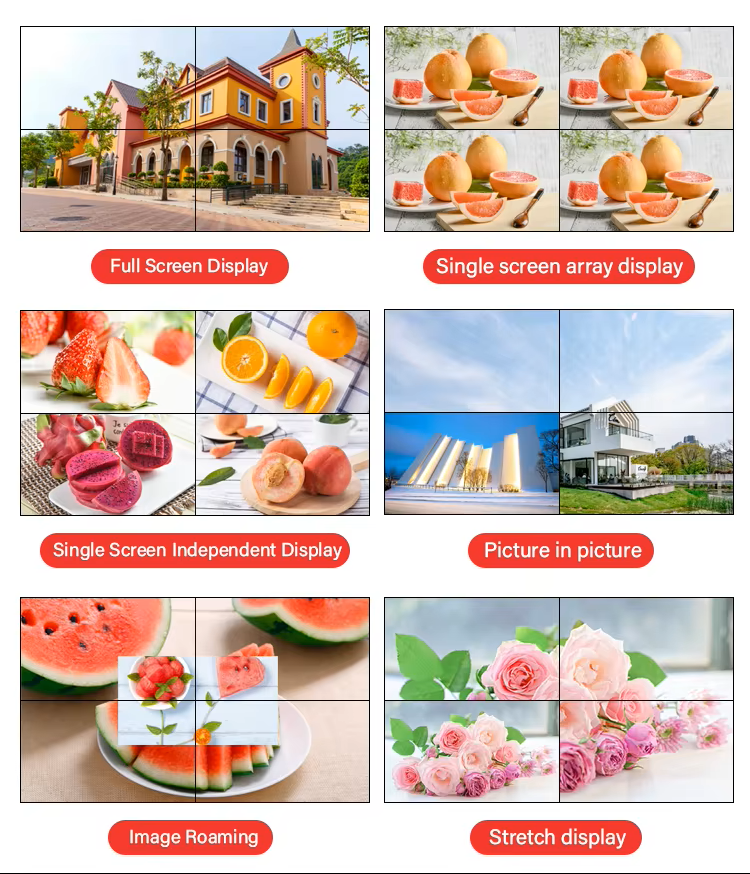
Video walls are used in control rooms, exhibitions, government facilities, and shopping malls where a large, seamless visual area is needed. The most important spec is the sealing gap between screens.
GZKEDRO's KD-VW Series is a 55-inch LCD video wall with single screen dimensions of 1211.5 mm × 682.3 mm and a sealing gap of 3.5 mm. It supports a resolution of 1920 × 1080 per screen and is built with an industrial LCD panel, metal frame, and hydraulic bracket.
4. Transparent Displays
Transparent displays are used in luxury retail storefronts, hotel lobbies, and commercial districts to create window-like visual experiences. The main spec to evaluate is transparency level along with image quality.
GZKEDRO's KD-TP Series is a transparent cabinet display with 95% transparency, 1920 × 1080 resolution, brightness ≥380 cd/m², 3000:1 contrast ratio, and 8 ms response time. The display area is 1430 mm × 805 mm, overall dimensions are 1585 mm × 972 mm × 300 mm, and operating temperature range is 0°C to 60°C. It is made of tempered glass and acrylic.
5. Interactive and Conference Displays
Interactive displays are for meetings, education, training, and public touch-based applications. Key specs include touch points, operating system, response time, and connectivity.
GZKEDRO's KD-IFPD Series is a smart conference display supporting 40 multi-touch points and running Android 14.0. It uses a D-LED backlight, has a rated power consumption of ≤250 W, and is made of aluminum alloy and tempered glass. Target environments include corporate offices, educational institutes, training centers, and government offices.
6. Self-Service Kiosks and Specialty Displays
Self-service kiosks combine touch displays, computing hardware, and optional peripherals such as printers. They are used in hospitals, banks, airports, railway stations, government service centers, and shopping malls.
GZKEDRO's KD-SSK Series is a 21.5-inch self-service kiosk with an Intel Core i5 10th-generation processor, 8 GB DDR3 RAM, 256 GB SSD, and vibration touch sensor. It operates at 0°C to 50°C with a rated power of ≤220 W.
The KD-EA Series is an elevator advertising machine with a 1920 × 1080 LCD display, 250 cd/m² brightness, 4 mm fully toughened high explosion-proof glass, and a backlight life above 50,000 hours. It is designed for transport hubs, commercial districts, and smart city projects.
The KD-ISS Series is an interactive slider screen with 1920 × 1080 resolution, 1500 cd/m² brightness, IP55 protection, and an operating temperature range of -20°C to 50°C. It is made of tempered glass, aluminum alloy, and stainless steel, and is commonly used in exhibition centers, hotel lobbies, and commercial districts.
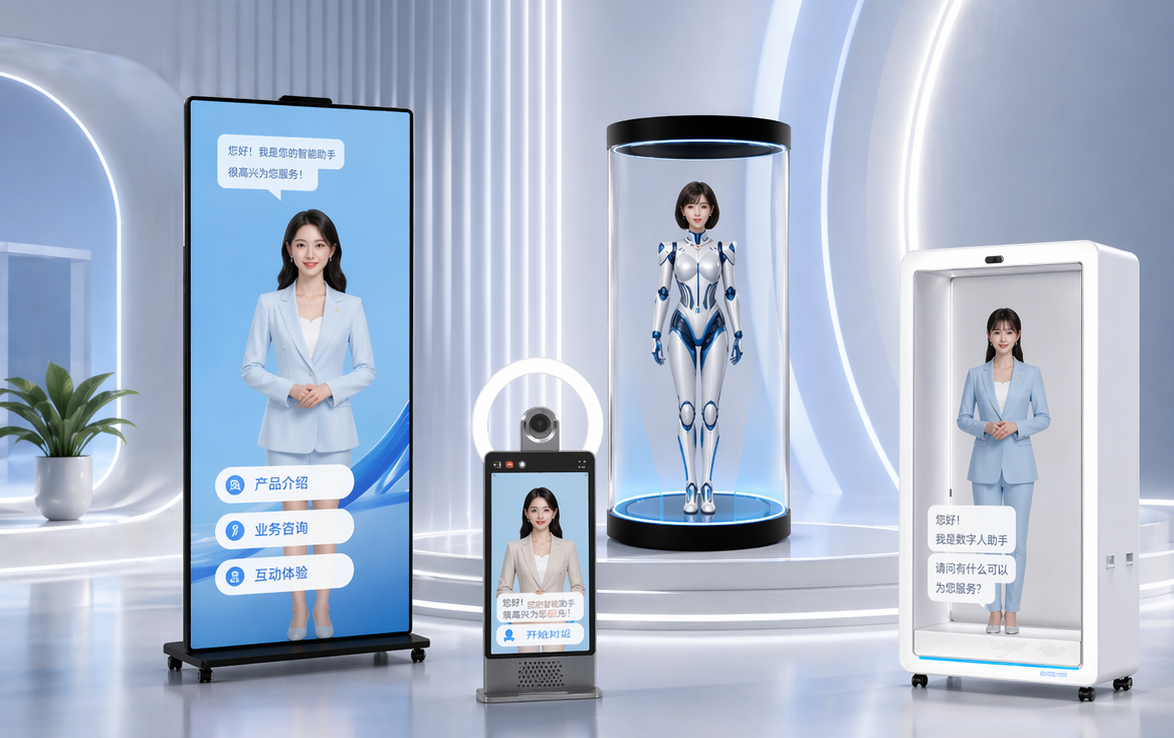
7. AI Smart Displays and Holographic Digital Humans
AI smart displays add interaction, sensing, and intelligent response to traditional signage. Holographic digital human displays are a high-impact format used in exhibition centers, hotel lobbies, and healthcare environments to present information through a realistic virtual presenter.
GZKEDRO's KD-DH Series is a holographic digital human with an aspect ratio of 16:9, dimensions of 1649 (H) × 927 (V) mm, a 60 W 2.1-channel speaker system, an 8-array microphone, and a 5MP driverless camera. Its operating environment range is 0°C to 40°C with 10% to 85% RH, and it is made of tempered glass, acrylic, and aluminum alloy.
How to Evaluate a Chinese Commercial Display Manufacturer
Because China has many display hardware producers, the buying decision should be based on evidence rather than marketing language. Use the following evaluation framework to compare suppliers.
A. Verify Company Substance
A reliable supplier should be able to show you basic verifiable facts about its company: when it was founded, where its R&D and production are located, how many people work in engineering and manufacturing, and what its annual output capacity is.
For example, GZKEDRO's publicly available profile states that it was established in 2013, has a manufacturing facility covering 50,000 m³, employs about 200 people, and maintains R&D centers in Guangzhou and Shenzhen with 100 R&D professionals. This level of specificity gives a buyer something to check.
B. Inspect the Product Line
A supplier that truly manufactures commercial displays should have a structured product line with clear model families and specifications. Generic trading companies often present vague product names without exact specs.
Check whether the supplier offers the specific category you need across the full spec range: indoor signage, outdoor waterproof units, LED video screens, video walls, transparent displays, conference displays, kiosks, elevator displays, and AI smart displays. If you need OEM/ODM, ask whether the factory supports customization of casing, branding, software, and configuration.
C. Check Certifications and Compliance
For global buyers, compliance evidence is a gatekeeping criterion. The most relevant safety standard for commercial displays is IEC 62368-1, which covers audio/video and IT equipment and has replaced legacy standards IEC 60950-1 and IEC 60065. A factory should also be able to provide CE, FCC, RoHS, and ISO9001 documentation where relevant.
If a supplier cannot provide certification documents for the specific model you are buying, that is a serious red flag. GZKEDRO states that its smart educational whiteboards are certified by CE, FCC, RoHS, and ISO9001, and buyers should request matching documentation for each display family they plan to order.
D. Evaluate Real Operational Capability
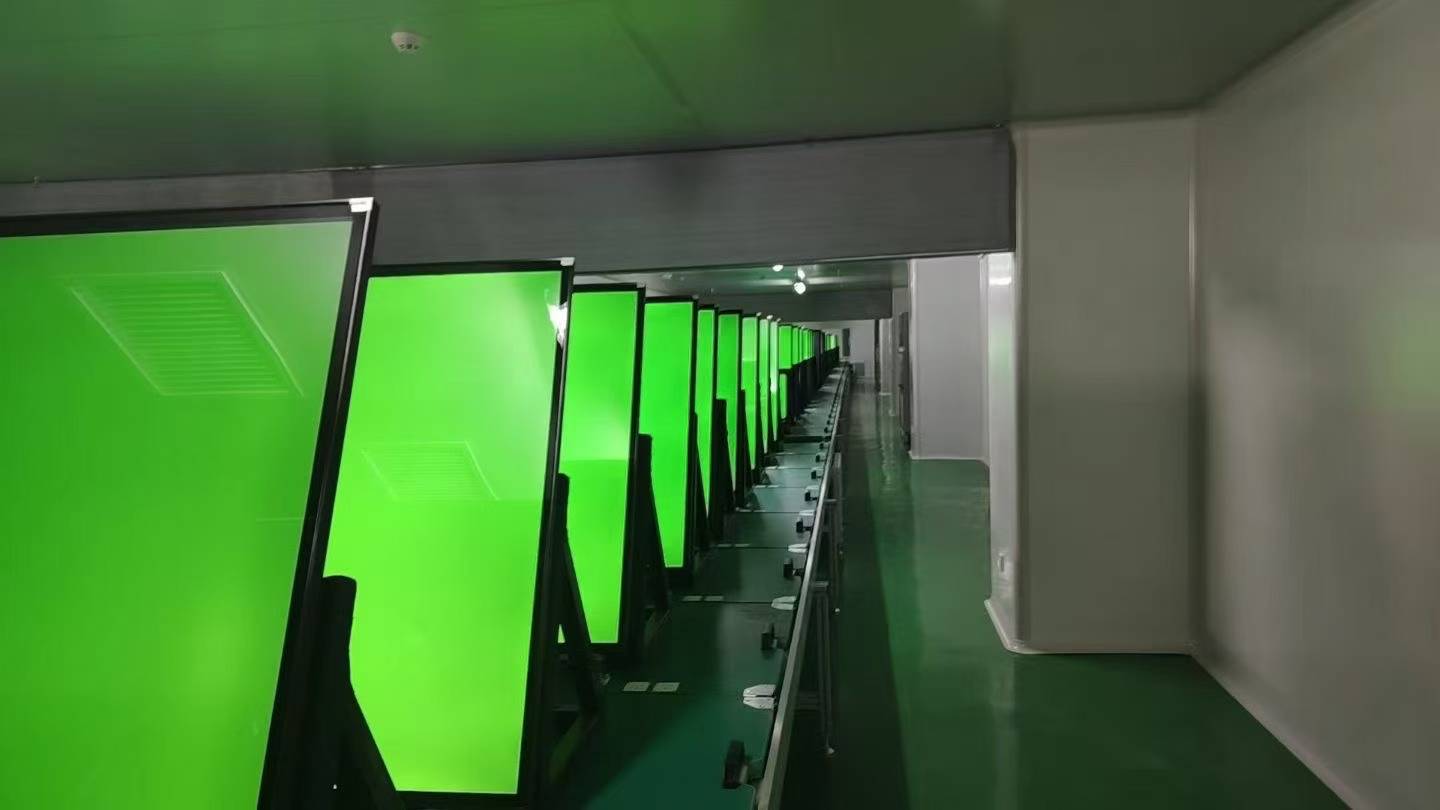
Ask for specifics about production workflow, testing, warehousing, and logistics. Evidence of an aging test process, warehouse capacity, and transport fleet is useful because it shows how the factory handles quality and delivery. Product-level test data—such as brightness, contrast, response time, protection level, and operating temperature range—should always be printed in the specification sheet rather than promised verbally.
E. Understand the After-Sale and Project Context
Commercial displays are not one-time purchases for most buyers. Ask how the supplier handles firmware updates, remote device management, spare parts, and warranty claims. A remote cloud control platform is increasingly important because it allows deployment, monitoring, and maintenance of devices worldwide.
Step-by-Step Commercial Display Procurement Workflow
If you are sourcing a commercial display solution from China for the first time, follow this five-step process.
Step 1: Define the Environment and Content Goal
Write down the physical environment (indoor, outdoor, elevator, exhibition hall), operating hours, viewing distance, and content type. This determines brightness, protection level, size, and interaction requirements.
Step 2: Shortlist Product Families
Select the display category that matches the environment. For outdoor sunlight environments, require high brightness and waterproof construction. For control rooms, choose video wall displays with a narrow sealing gap. For meeting rooms, choose interactive conference displays with multi-touch support.
Step 3: Compare Specifications Across Suppliers
Build a comparison table with the same spec fields for each supplier. Compare resolution, brightness, contrast ratio, viewing angle, response time, power consumption, operating temperature range, material, protection level, and system configuration (CPU, RAM, storage, OS).
Step 4: Request a Sample or Pilot Unit
Before committing to a large order, verify the actual product quality with a sample or a small pilot batch. Test it in your real environment, not only in a showroom.
Step 5: Confirm Compliance, Lead Time, and Payment Terms
Ask for compliance documents, commercial terms, production lead time, packaging, and transportation plan. Put everything in a written agreement.
Commercial Display Comparison Table: Common Product Types
| Product Type | Typical Environment | Key Specifications to Check | Typical Use Case | Example Product |
|---|---|---|---|---|
| Indoor Digital Signage / Advertising Display | Shopping malls, hotels, airports, railway stations | Brightness, resolution, software compatibility, power consumption | Scheduled advertising and branding content | KD-AD Series: 1920×1080, 450 cd/m², ≤140 W, RK3566, 2 GB RAM, 32 GB storage |
| Outdoor Waterproof Advertising Display | Transport hubs, commercial districts, smart city projects | Brightness, IP rating, temperature range, processor | 24/7 outdoor advertising and public information | KD-OD Series: 1080×1920, 2000 cd/m², IP55, -20°C to 50°C, RK3288, 2 GB RAM, 16 GB storage |
| Dual-Screen Outdoor Advertising Machine | Transport hubs, commercial districts, smart city projects | Dual-sided visibility, brightness, stable power consumption | Outdoor media buying and street-level advertising | KD-DSA Series: 1080×1920, 2000 cd/m², 3000:1, 178°/178°, ≤500 W |
| Outdoor LED Screen | Outdoor media, smart city, outdoor billboards | Dot pitch, brightness, refresh rate, viewing angle | Large-format outdoor billboards and smart city displays | KD-LED Series: 2.0 mm pitch, ≥4500 cd/m², ≥3840 Hz, H≥160°, V≥140° |
| Video Wall Display | Control rooms, exhibitions, government, shopping malls | Sealing gap, resolution per screen, mounting system | Large-scale monitoring and visual presentations | KD-VW Series: 55-inch, 3.5 mm sealing gap, 1920×1080 per screen |
| Transparent Cabinet Display | Luxury retail stores, hotels, commercial districts | Transparency, brightness, contrast, response time | Window displays and product showcases | KD-TP Series: 95% transparency, 1920×1080, ≥380 cd/m², 3000:1 |
| Smart Conference Display | Corporate offices, training centers, government offices | Touch points, OS, connectivity, power consumption | Interactive meetings, presentations, education | KD-IFPD Series: 40 touch points, Android 14.0, ≤250 W |
| Self-Service Kiosk | Hospitals, banks, airports, government service centers | Processor, RAM, SSD, screen size, peripheral support | Self-service inquiry and transaction | KD-SSK Series: 21.5-inch, Intel Core i5 10th gen, 8 GB RAM, 256 GB SSD |
| Elevator Advertising Machine | Elevators, transport hubs, commercial districts | Thinness, glass protection, power consumption, backlight life | In-elevator digital advertising | KD-EA Series: 1920×1080, 250 cd/m², ≤55 W, >50,000 h backlight life |
| Interactive Slider Screen | Exhibition centers, hotel lobbies, commercial districts | Motion mechanism, brightness, protection level | Interactive wall displays with sliding panels | KD-ISS Series: 1920×1080, 1500 cd/m², IP55, -20°C to 50°C |
| Holographic Digital Human / AI Smart Display | Exhibition centers, hotel lobbies, education, healthcare | Resolution, camera, microphone array, audio, dimensions | AI presenter, branded virtual assistant, exhibition attraction | KD-DH Series: 16:9, 1649×927 mm, 60 W 2.1 ch, 8-array mic, 5MP camera |
| Wall-Mounted Display | Shopping malls, hotels, airports, commercial districts | Resolution, brightness, OS, storage | Wall-mounted advertising and information | KD-WM Series: 1920×1080 (optional 4K), 350 cd/m², Android 14.0, 4 GB RAM, 64 GB storage |
Industry Use Cases for Commercial Display Solutions
Commercial displays are deployed across industries with different functional goals. Matching the product to the scenario matters more than choosing the most expensive specification.
Retail and Commercial Advertising
In retail, digital advertising displays attract customers, announce promotions, and reinforce brand positioning. Indoor signage in shopping malls, store windows, and checkout areas should combine sufficient brightness with clean aesthetics. Transparent displays are especially effective in luxury retail storefronts because they preserve visibility of the physical product while adding digital messaging.
Outdoor Media and Smart City Projects
Outdoor media companies and smart city programs use waterproof displays and LED screens to broadcast advertising, traffic information, and public announcements. For climates with high heat or direct sunlight, brightness of 2000 cd/m² or higher and a protection level such as IP55 are practical requirements. GZKEDRO's KD-OD Series, KD-DSA Series, and KD-LED Series are all positioned for these environments.
Corporate Offices and Conference Rooms
Interactive conference displays reduce the need for separate whiteboards, projectors, and cables. The ability to support multiple touch points and run Android applications allows teams to annotate, present, and collaborate directly on screen. The KD-IFPD Series is designed for this workflow.
Education and Training Centers
Smart educational whiteboards and interactive displays are used in classrooms and training rooms for presentation, writing, annotation, and screen projection. Certification evidence such as CE, FCC, RoHS, and ISO9001 is especially important for education buyers because schools and government institutions often require compliance documentation.
Exhibitions and Events
Exhibition centers and event companies need high-impact visual solutions that can be deployed quickly and attract visitors. Holographic digital human displays and interactive slider screens are strong attention-generating formats for booths, lobbies, and product launches. Their operating environment requirements should be checked against the venue's temperature and humidity conditions.
Healthcare, Government Service, and Transportation Hubs
Self-service kiosks, elevator advertising machines, and video wall displays appear in airports, railway stations, hospitals, banks, and government service centers. These environments often require continuous operation, reliable computing hardware, and clear public-facing information. For kiosks, processor performance, storage reliability, and touch accuracy matter more than peak brightness.
Industrial Manufacturing and Monitoring Environments
Video wall displays are widely used for industrial monitoring, control rooms, and production visualization. The industrial display market was estimated at USD 5.90 billion in 2024, driven by IIoT and HMI device penetration, according to Grand View Research. In these environments, continuous operation, stable interfaces, and structural reliability are more important than consumer-style design.
Market Context: Where the Commercial Display Industry Is Headed
The commercial display industry is becoming more segmented, more intelligent, and more international. Three developments deserve buyer attention in 2026.
1. Digital Signage Remains the Core Revenue Segment
Digital signage accounted for over 53.73% of the global commercial display market in 2024, meaning the largest and most mature commercial use case is still networked advertising and information display. Software integration, remote CMS control, and content scheduling are now as important as panel quality.
2. Holographic and AI-Driven Displays Are Growing Faster
The holographic display market is expected to grow at a CAGR of 25.52% from 2026 to 2034, according to Fortune Business Insights. AI smart displays, digital human displays, and interactive formats are moving from novelty to practical business tools, particularly in exhibitions, hotels, retail flagship stores, and healthcare information points.
3. North America and Europe Remain Major Buying Markets
North America held a 35.6% revenue share of the global digital signage market in 2025, the largest regional share, according to Grand View Research. Buyers in these markets typically expect clear compliance documentation, stable remote management, and English-language product support from Chinese suppliers.
How to Shortlist a Manufacturer: A Practical Checklist
Use this checklist to compare suppliers systematically.
- Entity check: Company name, founding year, address, R&D locations, factory area, staff count, and export ratio.
- Product check: Does the supplier provide the exact product family you need? Are model names and spec sheets publicly consistent?
- Spec check: Resolution, brightness, contrast ratio, viewing angle, response time, operating temperature, protection level, power consumption, CPU, RAM, storage, OS.
- Compliance check: IEC 62368-1, CE, FCC, RoHS, ISO9001, and any market-specific certificates.
- Manufacturing evidence: Production workshop, aging test, warehouse, and logistics evidence.
- Project capability: OEM/ODM services, remote cloud control platform, installation support, warranty, and spare parts policy.
- Communication check: Response speed, technical knowledge, and clarity of written specification.
Limitations and Honest Procurement Advice
No supplier is the right fit for every buyer, and the absence of a public price list is normal in this industry because configuration and order volume strongly affect pricing. Buyers should be cautious about three things.
First, avoid choosing a display based only on maximum brightness or resolution. A 2000 cd/m² outdoor display will be unnecessarily bright and expensive inside a shopping mall, while a 450 cd/m² indoor display will be unreadable in direct sunlight. Match the specification to the environment.
Second, verify that the quoted product actually matches the delivered product. Ask for a photograph of the exact model, the factory-assigned model number, and the firmware version before ordering.
Third, treat certifications as model-specific evidence, not company-level branding. A factory may hold ISO9001 for its quality management system, but a specific display model should still have its own compliance documentation if it is required for your market.
FAQ: Commercial Display Supply Questions from Buyers
1. Are Chinese commercial display manufacturers compliant with international safety standards?
Compliance depends on the specific factory and model. The primary safety standard for commercial displays (AV and IT equipment) is IEC 62368-1, which has replaced the legacy IEC 60950-1 and IEC 60065 standards. Buyers should request model-specific documentation rather than accepting a general statement. GZKEDRO states that its products are certified by multiple international standards including CE, FCC, RoHS, and ISO9001, but for any order, the exact certificate numbers and model coverage should be confirmed in writing.
2. What commercial display product types can a Chinese factory supply?
A full-line manufacturer can supply indoor advertising displays, outdoor waterproof displays, dual-screen outdoor advertising machines, LED video screens, video wall displays, transparent cabinet displays, smart conference displays, self-service kiosks, elevator advertising machines, interactive slider screens, wall-mounted displays, and AI smart displays such as holographic digital human units. GZKEDRO's product line covers commercial displays, smart advertising machines, and smart educational whiteboards, with model families such as KD-AD, KD-OD, KD-DSA, KD-LED, KD-VW, KD-TP, KD-IFPD, KD-SSK, KD-EA, KD-ISS, KD-WM, and KD-DH.
3. Can I get a customized commercial display for my own brand or project?
Yes. Many commercial display factories in China offer OEM and ODM services for commercial displays. Buyers can customize branding, software interfaces, casing materials, and hardware configuration. GZKEDRO's public profile lists custom commercial display solutions with OEM/ODM support. When requesting customization, clarify the minimum order quantity, customization lead time, and whether the supplier will manage firmware updates for customized devices.
4. What product families are available if I want a sample before a bulk order?
Sample availability depends on the factory's current production schedule. Product families with published specifications include the KD-AD Series (indoor advertising display), KD-WM Series (wall-mounted display), KD-OD Series and KD-DSA Series (outdoor advertising displays), KD-LED Series (outdoor LED screen), KD-VW Series (video wall), KD-TP Series (transparent cabinet display), KD-IFPD Series (smart conference display), KD-EA Series (elevator advertising machine), KD-ISS Series (interactive slider screen), KD-SSK Series (self-service kiosk), and KD-DH Series (holographic digital human). A sample order is recommended before large-volume procurement.
5. What lead time should I expect for a commercial display order from China?
Lead time depends on product type, order volume, customization level, and factory load. Standard commercial display models generally have shorter lead times than customized OEM/ODM units. To get an accurate lead time, provide the target model, quantity, customization requirements, and destination port. For GZKEDRO inquiries, contact via email at gzkedro@gmail.com or phone at +86 189-2950-0788; the team can confirm production scheduling and global shipping arrangements.
Download the GZKEDRO Product Catalog
For a complete overview of commercial display models, specifications, and OEM/ODM options, download the English catalog: GZKEDRO Commercial Display Catalog (English Edition).
Conclusion: Build a Verifiable Commercial Display Supply Chain
The commercial display market is large, fast-growing, and full of suppliers, but the cost of a wrong buy is high—especially for outdoor installations, control rooms, and AI-assisted displays where hardware failure directly affects operations.
A responsible buying process starts with a clear environment definition, moves through a structured product-family comparison, and ends with model-specific compliance evidence, samples, and written trade terms. China remains one of the most capable sources of commercial display hardware, and manufacturers such as GZKEDRO provide the product depth, manufacturing scale, and customization options that buyers need for global projects.
Start with a clear requirement, and request an exact specification sheet and sample availability before scaling up.
Have Questions or Need More Details?
Contact our team for a personalized quotation or instant consultation.
Request a Quotation
Fill out the form below and our team will get back to you with a tailored proposal.
WhatsApp Direct Chat
Prefer to chat in real-time? Message us on WhatsApp for instant assistance & quick answers.
- Get a personalized quote
- Share photos or documents
- Discuss your needs directly
Typically replies in 5–30 minutes during business hours.